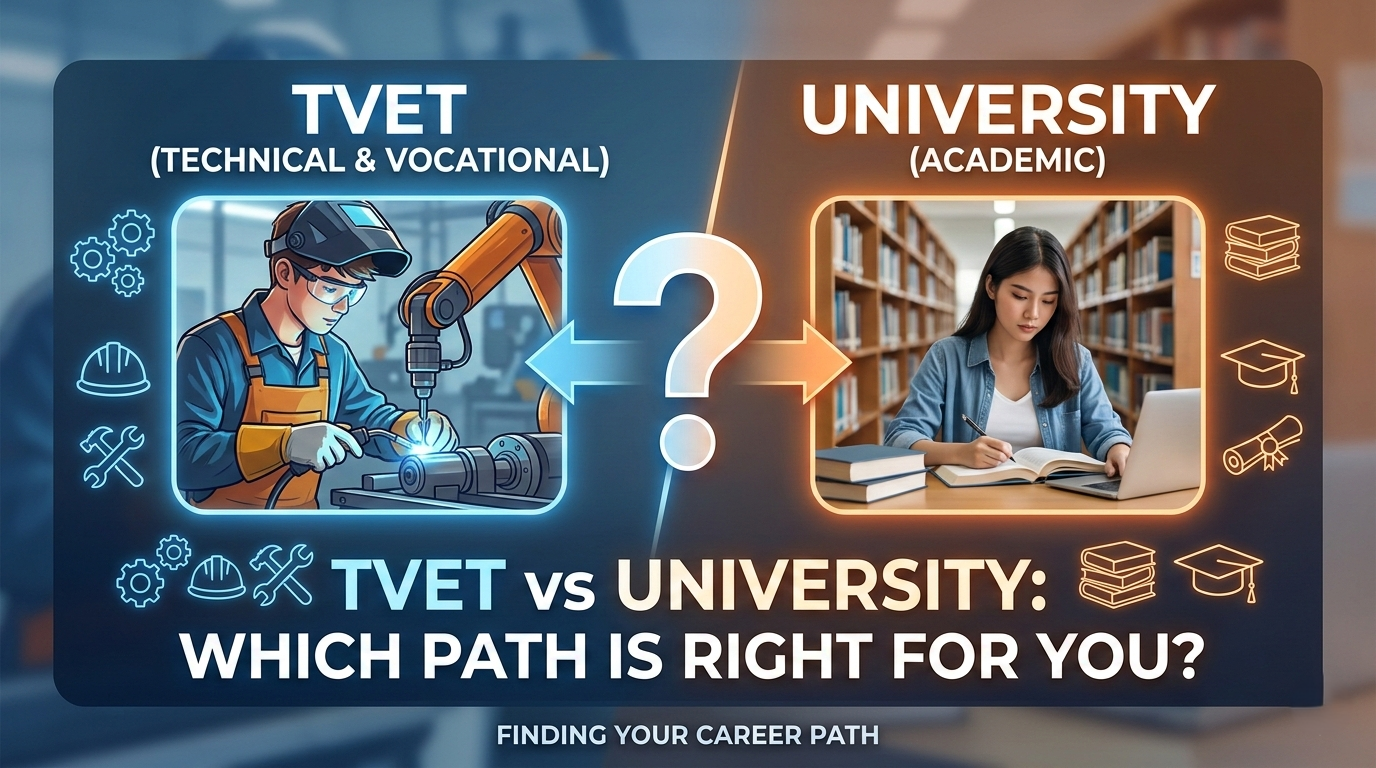
Every year, thousands of Grade 12 learners sit with their Matric results in hand — and no clear idea of what to do next. The pressure is real. Parents expect university. Teachers point to degrees. Society whispers that anything less is failure.
But here is a hard truth South Africa rarely speaks out loud: youth unemployment is above 60%, and a large portion of those statistics are university graduates sitting with expensive degrees and no job. Meanwhile, the country is importing skilled artisans from abroad because we do not have enough of them locally.
So the real question is not “Which option sounds better?” The real question is: “Which option will actually get you working?” This guide breaks down the TVET College vs University debate honestly, practically, and without the stigma — so you can make the decision that is right for you.
What Is a TVET College?
A TVET (Technical and Vocational Education and Training) college is a government-supported institution that teaches practical, trade-specific skills. There are 50 public TVET colleges across all nine provinces of South Africa.
TVET colleges offer two main qualification streams:
- NCV (National Certificate Vocational) — Levels 2 to 4, accessible from Grade 9. This is the vocational equivalent of Matric.
- NC(V) Report 191 (N1 – N6) — The traditional engineering and business studies route leading to an N6 certificate.
To convert an N6 Certificate into a full National Diploma (NQF Level 6), students must complete 18 months of approved workplace experience — meaning you graduate with real, documented work experience already on your CV.
What Is a University?
A university is an academic institution focused on theoretical knowledge, research, and professional qualifications. South Africa has 26 public universities, ranging from traditional research universities like UCT and Wits to universities of technology.
Universities offer qualifications at NQF Level 7 (Bachelor’s degree) and above, including Honours, Master’s, and Doctoral degrees. Entry requires a Matric with a
- Bachelor’s Pass (typically an APS score of 28 or higher, and often 35+ for competitive programmes like Medicine or Law).
- Strong subject marks in relevant fields (e.g., Mathematics for Engineering, Life Sciences for Medicine).
Read: List of all 26 South African Universities
TVET College vs University: Side-by-Side Comparison
Before going deeper, here is a quick comparison of the most important factors:
| Factor | TVET College | University |
| Entry Requirement | Grade 9 (NCV) or Matric with Diploma Pass | Matric with Bachelor’s Pass (APS 28+) |
| Study Duration | 1 – 3 years | 3 – 4+ years |
| Annual Fees | R8,000 – R25,000 | R20,000 – R60,000 |
| NSFAS Funding | Yes – eligible | Yes – eligible |
| Qualification Level | NQF Level 4 – 6 (N6 / National Diploma) | NQF Level 7 (Bachelor’s Degree) |
| Focus | Practical, hands-on, trade-specific | Theoretical, research, analytical |
| Work Experience | 18-month in-service training required | Often zero work experience at graduation |
| Job-Readiness | High – industry-aligned skills | Variable – depends on field |
| Career Flexibility | Specific trades and vocational fields | Wide range of professional fields |
| Progression | Can articulate to University of Technology | Can continue to Honours/Master’s/PhD |
The Main Difference Between TVET and University
1. Learning Style: Practical vs. Theoretical
This is perhaps the most important distinction. Universities offer courses that are long-term and more theoretical, while TVET colleges provide a hands-on learning experience where students often split their time between classroom instruction and real-world training in workplaces or simulated environments.
Think about it this way: a Civil Engineering student at university spends years studying the physics of load-bearing structures. A Civil Engineering student at TVET learns how to mix concrete, weld beams, and read a construction site plan. One designs the bridge; the other builds it.
If you’ve always been someone who learns by doing — someone who takes apart machines just to see how they work, or someone who gets bored reading textbooks but lights up in a workshop — TVET is likely your natural home.
2. Duration and Time to Employment
Time is money. At university, you’re looking at a minimum of three to four years before you enter the workforce. At TVET, many programmes are completed in two to three years, and some certificates take as little as a few months.
TVET students complete 18 months of classroom work followed by 18 months of practical industry experience — meaning they graduate with real, employer-ready work experience already under their belt. Compare that to a university graduate who often enters the job market with zero practical experience.
Salary Potential
This is more nuanced than people think.
Yes, university graduates in professional fields like law, finance, and medicine typically earn higher starting salaries. But the picture changes dramatically in the skilled trades.
- A qualified electrician in South Africa can earn R25,000 – R45,000 per month as a self-employed contractor.
- An underwater or petrochemical welder can out-earn a corporate manager.
- A qualified plumber running their own business has effectively no ceiling on income.
- A generic BA graduate may start at R8,000 – R12,000 per month and wait years for meaningful progression.
The lesson? A skilled TVET graduate in a scarce-skills trade can earn more than a university graduate in an oversupplied field. Earnings depend on the specific qualification and industry — not just the type of institution.
3. Entry Requirements
This is where TVET colleges have a major advantage, especially for students who did not pass Matric with flying colours.
TVET College Requirements
- NCV Programmes: Require only a Grade 9 certificate. Matric is NOT required.
- N1 – N6 Report 191 Programmes: Generally require at least a Matric with a Diploma Pass.
- No minimum APS score for most programmes — access is much wider.
This is the path that guidance counsellors rarely mention: if you failed Matric or did not achieve a Bachelor’s Pass, a TVET college allows you to reset your career without repeating high school.
University Requirements
Specific subject requirements vary by faculty — for example, Engineering requires a strong pass in Mathematics.
Bachelor’s Pass required: At minimum, you need 40% in four subjects including an official language.
APS Score of 28+: Competitive programmes like Engineering, Medicine, or Law require 35–42+.
4. Cost and Financial Accessibility
Cost is one of the most important factors for most South African families — and TVET colleges win this round clearly.
TVET College Fees
- Annual tuition typically ranges from R8,000 to R25,000 per year.
- Most programmes are NSFAS-funded, covering tuition, accommodation, and a monthly living allowance.
- Shorter programmes mean fewer years of fees to pay.
University Fees
- Annual tuition ranges from R20,000 to R60,000 depending on the faculty.
- NSFAS funding is available, but competition is high and the gap between what NSFAS covers and actual costs can be significant.
- A 4-year degree could cost a family R80,000 – R240,000+ in total tuition before accommodation and books.
Note: Both TVET colleges and universities qualify for NSFAS funding. If you come from a household earning less than R350,000 per year, you may qualify. Apply as early as possible — NSFAS applications open before the academic year begins.
5. Qualifications and the NQF
Many people worry that a TVET qualification carries less weight. The gap is smaller than you think. University graduates typically finish at NQF Level 7, while TVET graduates finish at NQF Level 6 after completing their 18 months of in-service training. That is one level of difference — not the chasm that social stigma suggests.
Which Is Best? (TVET vs University)
Here’s a truth that should reframe this entire debate: the world is desperately short of skilled workers.
Jobs in skilled trades cannot be replaced by machines or shipped overseas. Electricians, HVAC technicians, carpenters, and welders all bring specialised skills that require hands-on experience and attention to detail.
Three in four companies are currently struggling to find qualified workers, and many young people are turning toward hands-on trade jobs specifically because AI cannot threaten their long-term employability.
Over 211,100 new skilled trade jobs are projected by 2033, with a nationwide labour shortage leaving millions of positions unfilled. The American Welding Society, for example, projects a shortage of hundreds of thousands of welders. Electricians are generating 80,000 job openings annually.
This is not just a construction story. TVET graduates in IT, cybersecurity, data analytics, renewable energy, and healthcare support are in similarly high demand globally.
More than seven in ten employers worldwide reported difficulty finding the talent they need in 2026. Employers are not just hiring degrees anymore — they are hiring skills and demonstrated competence.
The number of HR leaders likely to use skills-first hiring — which focuses on certifications and non-degree education — has tripled in just two years.
That is a seismic shift in how the world works, and it should inform every conversation you have about your future.
Read: High-demand TVET courses.
So, Which Path Is Right for You? Ask Yourself These 5 Questions
Choosing between TVET and university is not about prestige. It’s about fit. Here are five honest questions that can clarify your decision:
1. How do you learn best? Do you thrive in classrooms, writing essays and engaging with abstract ideas? Or do you come alive when you’re building, fixing, cooking, coding, or creating with your hands? Your answer is one of the most reliable guides you have.
2. What career do you actually want? If you want to become a doctor, lawyer, accountant, or research scientist, you need a university degree — full stop. But if you want to become an electrician, IT technician, plumber, chef, automotive mechanic, or renewable energy installer, a TVET college is likely the better choice, as it delivers the specific practical training those careers require.
3. How much time and money can you invest? If you or your family are financially stretched, spending four or more years at university — potentially accumulating significant debt — is a serious risk, especially if job placement is uncertain. TVET offers a faster, cheaper route to an income.
4. Do you want to work for someone else, or eventually run your own business? Skilled tradespeople frequently become entrepreneurs. A qualified plumber or electrician can start their own business within a few years of graduating. TVET training builds the practical foundation for self-employment far more directly than most university degrees.
5. Are you choosing university because you want to, or because you feel you have to? This is the most important question of all. Not everyone needs a university education to contribute meaningfully to the economy — what matters is that skills are directed where they are genuinely needed. If you are choosing university purely because of social pressure, it is worth pausing and reconsidering.
What About Combining Both? Bridging the Gap
One of the most encouraging developments in modern education is that these two paths are no longer mutually exclusive. Many TVET graduates use bridging programmes and recognition of prior learning (RPL) to enter universities of technology or to access advanced standing in degree programmes.
Both institutions provide pathways for students to move from vocational to academic programmes or vice versa, ensuring that all learners have opportunities to succeed in their chosen fields.
This means starting at TVET is not a closed door. It can, in fact, be a smarter on-ramp — entering the workforce quickly, earning while learning, building practical experience, and then advancing academically when the time is right.
There Is No Universal “Better” — Only What Is Right for You
The TVET College vs University debate does not have one correct answer. Both pathways lead to real careers, real income, and real futures. What matters is that you choose the path that matches your goals, your strengths, and your reality.
If you are a Grade 12 learner figuring out your next step, a parent advising your child, or an unemployed adult considering a second chance — know this: choosing a TVET college is not giving up. It may be the smartest decision you ever make.
South Africa needs skilled, work-ready, determined people. Whether you build that future at a TVET college or a university, the country needs you. Your future is worth investing in — start now.
Disclaimer:
Information in this article is provided for general guidance only. Qualification requirements, NSFAS eligibility, and fee structures change regularly. Always verify the latest details with the specific institution or the official DHET/NSFAS website before making any application or financial decision.
