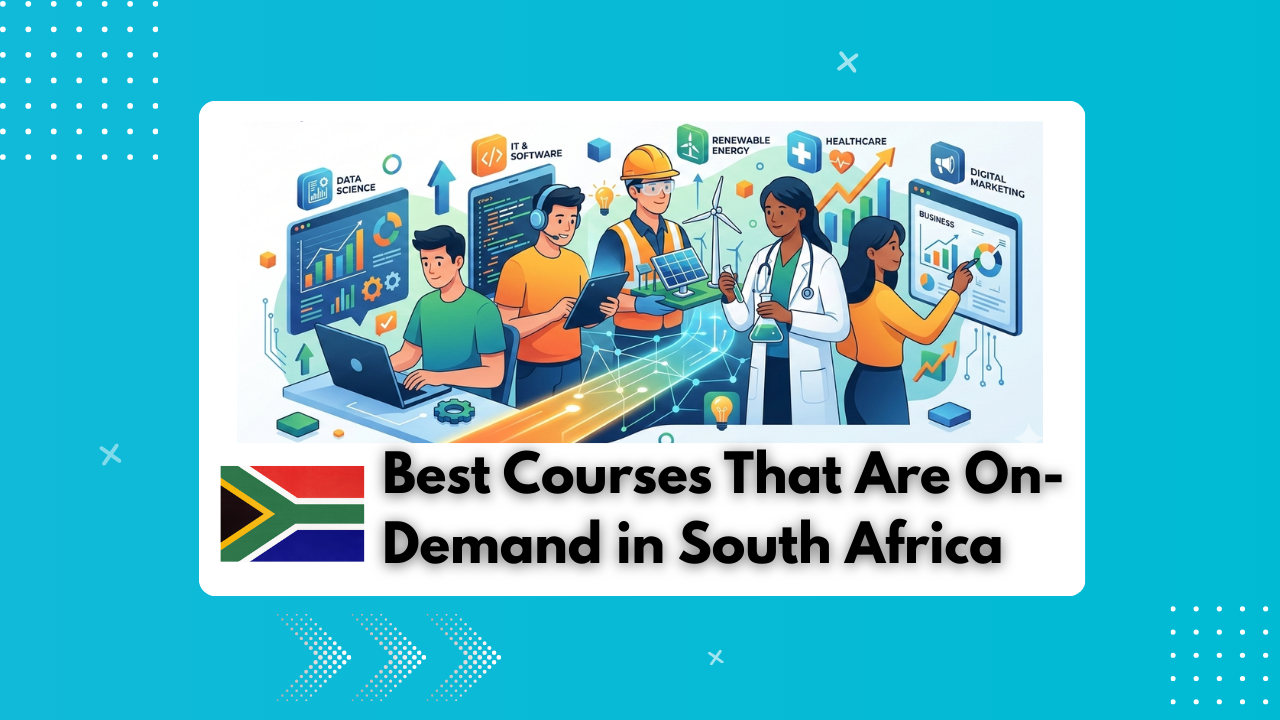
South Africa’s job market is undergoing its most significant structural shift in decades. Skills shortages, digital transformation, and a green economy transition are creating urgent demand for qualified professionals across tech, healthcare, finance, and construction. This guide covers the 10 best on-demand courses in SA in 2026, why each matters, what they pay, and exactly how to get started — whether you are a school leaver, career changer, or working professional looking to upskill.
Who This Is For
This guide is written for:
- Matric graduates deciding what to study and wanting to align their choices with real job market demand
- Working professionals who feel their current skills are becoming less relevant and want to pivot or upskill
- Unemployed or underemployed South Africans looking for the fastest credible path into a stable, well-paying career
- Career advisers, parents, and educators who want an honest, data-informed breakdown of where the South African job market is actually heading
This is not a list of trendy buzzwords. Every course covered here is backed by measurable employer demand, skills shortages data, or national priority investment — or all three.
Why 2026 Is a Pivotal Year for South African Career Planning
South Africa sits at an unusual crossroads in 2026. On one hand, the unemployment rate remains one of the highest in the world. On the other, employers across sectors are actively struggling to find skilled candidates to fill critical roles. That gap — between where skills are absent and where opportunity is concentrated — is exactly where smart career decisions get made.
Several forces are colliding to shape the current landscape:
Digital transformation is accelerating faster than the talent pipeline can respond. The International Data Corporation has predicted that 90% of organisations worldwide would face IT skills shortages by 2026. South Africa is no exception. Companies across banking, retail, mining, and government are digitising operations but cannot find enough qualified professionals to run them.
Microsoft committed to training 1 million South Africans in AI and cybersecurity skills. This signals not just goodwill but a calculated response to a genuine crisis. When one of the world’s largest technology companies prioritises a country for skills investment, the underlying demand is real and urgent.
The Future of Jobs Report 2026 found that more than 60% of South African companies identify skills gaps as a major obstacle to business transformation by 2030. That number should reframe how you think about a qualification. A degree or certificate is not just a personal achievement — in many sectors, you are solving a problem that companies genuinely cannot solve themselves.
The green economy is no longer aspirational — it is a procurement reality. South Africa’s accelerating investment in renewable energy infrastructure, driven by the energy crisis and international climate commitments, has created immediate demand for technically skilled workers who simply do not exist in sufficient numbers.
The Skills Development Act and the National Skills Fund continue to expand funding pathways, making upskilling more financially accessible than at any prior point. SETA funding, learnerships, and bursaries tied to scarce skills lists mean that the right course can sometimes cost you very little out of pocket.
In short: if you have been waiting for the right moment to invest in your education or career pivot, 2026 is that moment.
How We Selected These Courses
The courses on this list were evaluated against four criteria:
- Employer demand signal — Is there evidence of active, unfilled vacancies in South Africa requiring this skill set?
- Salary premium — Does the qualification command a meaningful income above the national median?
- Growth trajectory — Is this a field expanding, stabilising, or declining over the next five years?
- Entry accessibility — Can someone without a prior qualification in the field realistically begin this path?
Courses that cleared all four bars make this list. Courses that are fashionable but lack genuine local demand do not.
The Top 10 On-Demand Courses in South Africa 2026
1. Data Science and Analytics
Why it is in demand: Every industry in South Africa — from financial services to agriculture — is sitting on vast amounts of data and does not have enough people who know what to do with it. Data scientists and analysts transform raw information into decisions: pricing strategies, risk models, operational efficiencies, customer segmentation. Companies that master this earn more. Those that cannot find people to help them do it lose to competitors who can.
The demand is not theoretical. South African banks, insurers, retailers, and telecoms are all scaling data teams. Positions frequently go unfilled for months because the pipeline of trained professionals cannot keep up.
What you will learn: A solid data science course covers statistical thinking, Python or R programming, SQL for database querying, machine learning fundamentals, and data visualisation. The best programmes layer in business context — teaching you not just how to run an analysis but how to frame a business problem, communicate findings to non-technical stakeholders, and recommend action.
Entry point: Many credible short courses require only a matric certificate and basic numeracy. Full degree programmes at institutions like UCT, Wits, and UNISA require stronger academic foundations but offer deeper credibility.
Salary range: R480,000–R900,000+ annually depending on seniority and sector. Senior data scientists in financial services can earn significantly above this range.
Pro Tip: The most valuable early differentiator in data science is not the certificate — it is a portfolio of real projects. During your course, build two or three analyses on publicly available South African datasets (Stats SA releases excellent datasets). Post them on GitHub. This matters more to most employers than the institution you studied at.
2. Cybersecurity
Why it is in demand: South Africa ranks consistently among the most targeted countries for cybercrime globally. The financial sector, government departments, healthcare providers, and retailers have all suffered high-profile breaches in recent years. Every one of those incidents creates urgent board-level pressure to hire qualified security professionals. The problem is that the country has a fraction of the cybersecurity talent it needs.
What you will learn: Cybersecurity courses span network security fundamentals, ethical hacking (penetration testing), threat detection and incident response, compliance frameworks (POPIA is particularly relevant in the SA context), and cloud security. Entry-level certifications such as CompTIA Security+ are globally recognised and serve as a credible baseline.
The POPIA factor: South Africa’s Protection of Personal Information Act introduced legally enforceable data protection obligations. Every organisation that handles personal data — which is effectively every organisation — now needs professionals who understand both technical security and the compliance framework. This has created a layer of demand that did not exist three years ago.
Entry point: No specific prior qualification required for most entry-level certifications, though comfort with IT concepts accelerates progress considerably. CompTIA’s A+ or Network+ as a precursor is advisable for absolute beginners.
Salary range: Entry-level security analysts earn from R250,000–R400,000 annually. Experienced penetration testers and security architects can reach R700,000–R1.2 million, with senior specialists earning more.
Career paths from here: Security Analyst → Security Engineer → Penetration Tester → CISO (Chief Information Security Officer). The CISO role is among the highest-paid in South African technology.
3. Software Development and Full-Stack Engineering
Why it is in demand: South Africa’s software development talent shortage is acute enough that a significant portion of local companies hire remotely — and international companies now actively recruit South African developers precisely because of the time zone overlap with Europe and comparatively competitive salaries. This means qualifying as a software developer opens not just local but global job markets.
What you will learn: Full-stack development courses teach both front-end skills (HTML, CSS, JavaScript, frameworks like React) and back-end skills (Node.js, Python, databases, APIs). Cloud fundamentals — particularly AWS or Azure — are increasingly bundled into modern development curricula.
The misconception to address: Many people believe software development requires a four-year computer science degree. While a CS degree provides depth, many of South Africa’s most employable developers got there via intensive bootcamps or self-directed learning combined with a credible portfolio. What employers test is whether you can build things that work — not whether you studied at a specific institution.
Bootcamp vs. degree: A bootcamp (typically three to six months) can get you to junior developer level faster and at lower cost. A CS degree provides stronger fundamentals for senior roles, research, and architecture. For someone who needs to change careers quickly, a bootcamp followed by deliberate continued learning is a legitimate path.
Salary range: Junior developers start at R180,000–R320,000. Mid-level developers earn R400,000–R700,000. Senior developers command R800,000+ locally, with remote roles for international companies often paying in USD or EUR — substantially more.
Recommended providers: WeThinkCode (free, merit-based), CodeSpace Academy, HyperionDev, and Udemy paired with freeCodeCamp for self-directed learners.
4. Artificial Intelligence and Machine Learning
Why it is in demand: AI is no longer a technology of the future — it is a present reality reshaping finance, healthcare, agriculture, legal services, and manufacturing in South Africa right now. The companies implementing AI urgently need two types of people: those who can build AI systems, and those who can apply and govern them responsibly within business contexts.
What distinguishes this from data science: Data science focuses on analysing existing data to generate insight. AI and ML engineering focuses on building systems that learn, predict, and automate. In practice, the two fields overlap significantly, but a dedicated AI/ML course goes deeper into model architecture, neural networks, large language model deployment, and MLOps (the operational side of running AI systems in production).
Sector applications in SA: Banks use ML for credit scoring and fraud detection. Agricultural companies use computer vision for crop monitoring. Healthcare systems use predictive models for patient triage and resource allocation. Each application requires professionals who understand both the domain and the technology.
Entry point: A foundation in Python and basic statistics is strongly advisable before beginning an ML course. Most serious AI/ML programmes require this as a prerequisite.
Salary range: ML engineers in South Africa earn R550,000–R1.1 million annually. The field is young enough that credible experience compounds rapidly into seniority.
5. Renewable Energy and Sustainability
Why it is in demand: South Africa’s energy crisis created a national emergency — and a national opportunity. The accelerated rollout of solar, wind, and battery storage infrastructure requires engineers, project managers, environmental compliance officers, and technical specialists who simply do not exist in sufficient numbers. The government’s Integrated Resource Plan and private sector investment pipelines are committing billions of rands to projects that need skilled people to deliver them.
What you will learn: Renewable energy courses cover solar PV system design and installation, wind energy fundamentals, battery energy storage systems, grid integration, project economics, and environmental impact assessment. For those on a management track rather than a technical one, courses in energy project management and sustainability reporting (including ESG frameworks) are highly marketable.
The ESG angle: Environmental, Social, and Governance reporting is becoming a compliance requirement for listed companies and large private organisations. Professionals who can navigate ESG frameworks and produce credible sustainability reports are in significant demand across the corporate sector.
Entry point: Technical tracks typically require engineering or science background. Management and compliance tracks are more accessible to graduates from varied disciplines.
Salary range: Solar PV technicians earn R180,000–R350,000. Renewable energy engineers and project managers earn R500,000–R900,000. ESG specialists in large corporates earn R450,000–R800,000.
6. Project Management
Why it is in demand: Every organisation running a digital transformation, infrastructure build, or product launch needs project managers. The role transcends sector — a PM qualification is as valuable in construction as it is in banking or public health. This cross-sector portability makes it one of the most versatile qualifications you can pursue.
PMP vs. Prince2 vs. Agile: Three dominant frameworks operate in South Africa:
- PMP (Project Management Professional) is the globally recognised standard for traditional project management. It carries weight across industries and geographies.
- PRINCE2 is preferred in government and large infrastructure contexts, particularly in organisations with British-influenced processes.
- Agile/Scrum certifications (PSM, CSM, SAFe) are the standard in technology and software environments. A Scrum Master or Agile Coach certificate is often a faster entry point for those coming from a tech background.
What makes a great PM in the SA context: Beyond methodology, employers want project managers who understand stakeholder management in complex, diverse environments; who can navigate procurement and compliance requirements; and who can maintain delivery momentum when resource constraints — which are common in SA — disrupt plans.
Salary range: Junior PMs earn R300,000–R480,000. Senior PMs and Programme Managers earn R600,000–R1 million. PMO (Project Management Office) Directors earn more.
7. Healthcare Administration and Clinical Support
Why it is in demand: South Africa’s healthcare system faces a structural deficit: not enough trained professionals at every level, from clinical support to administration. A UNESCO report noted that sub-Saharan Africa needs millions more trained professionals in education and health to meet development targets by 2030. South Africa’s specific challenge is compounded by emigration of trained healthcare workers and growing demand from both the public health system and an expanding private sector.
What you will learn: Clinical support courses cover patient care fundamentals, healthcare safety protocols, medical terminology, and support procedures for nursing and therapeutic teams. Healthcare administration courses focus on health records management, coding and billing, facility operations, HR in clinical settings, and regulatory compliance.
The underrated opportunity: Most career guides focus on nursing and medicine — both of which are critical but require long qualification pathways. Healthcare administration and clinical support qualifications are shorter, more accessible, and equally in demand. A qualified medical records administrator or healthcare facility coordinator is not a backup plan — it is a career with real progression, stability, and social impact.
Entry point: Many programmes require only matric. Some clinical support roles require additional practical placement hours.
Salary range: Entry-level healthcare administrators earn R180,000–R280,000. Practice managers and senior administrators earn R350,000–R550,000.
8. Digital Marketing and Performance Marketing
Why it is in demand: South Africa’s internet penetration has grown significantly, and with it, the expectation that every business — from a Cape Town restaurant to a Johannesburg financial services firm — maintains a credible, converting online presence. The problem is that the marketing industry has not produced enough people who can actually deliver measurable results.
Traditional marketing vs. performance marketing: Traditional marketing focuses on brand awareness and audience reach. Performance marketing is ruthlessly measurable — every rand spent is tracked against specific outcomes: click-through rates, cost per acquisition, return on ad spend. Performance marketers who can demonstrate ROI are among the most hireable marketing professionals in South Africa today.
Core skills to prioritise: Google Ads and Meta Ads management, search engine optimisation (SEO), Google Analytics 4, email marketing automation (HubSpot, Mailchimp), and content strategy. Adding data analysis skills — even basic spreadsheet proficiency — dramatically increases your value.
Freelance potential: Digital marketing is one of the most accessible fields for freelancers and remote workers. A competent digital marketer can serve clients across South Africa, Africa, and internationally from anywhere with a reliable internet connection.
Salary range: Digital marketing coordinators earn R200,000–R320,000. Experienced performance marketers and SEO specialists earn R350,000–R600,000. Senior digital marketing managers earn R550,000–R900,000+.
9. Supply Chain and Logistics Management
Why it is in demand: South Africa’s logistics infrastructure is under pressure — port inefficiencies, road freight challenges, and rail network underperformance have put enormous emphasis on professionals who can optimise what the system has. Simultaneously, e-commerce growth is creating new last-mile logistics complexity. Companies across retail, mining, agriculture, and manufacturing all compete for the same thin pool of qualified supply chain professionals.
What you will learn: Supply chain courses cover procurement strategy, inventory control, demand forecasting, logistics network design, supplier relationship management, and the use of ERP systems (SAP is heavily used in large South African corporates, making SAP certification a valuable add-on).
The e-commerce driver: The growth of platforms like Takealot and the entry of international e-commerce players has created specific demand for last-mile logistics expertise, warehouse management systems knowledge, and returns management — a specialisation that barely existed in South Africa five years ago.
Entry point: Certificates and diplomas in supply chain are available at TVET colleges, universities of technology, and private providers. The Chartered Institute of Procurement and Supply (CIPS) qualification is internationally recognised and particularly valued in the corporate sector.
Salary range: Logistics coordinators earn R200,000–R380,000. Supply chain analysts and procurement officers earn R350,000–R600,000. Senior supply chain managers earn R650,000–R1 million+.
10. Human Resources and Labour Relations
Why it is in demand: South Africa’s labour law framework is among the most complex in the world. The Labour Relations Act, the Basic Conditions of Employment Act, POPIA’s implications for HR records, Employment Equity legislation, and the ongoing evolution of hybrid work arrangements all require skilled HR professionals who can keep organisations compliant, fair, and productive simultaneously.
What you will learn: HR courses cover recruitment and selection, performance management, training and development, compensation and benefits, employee relations, disciplinary procedures, and labour law fundamentals. Senior programmes add HR analytics, organisational development, and strategic workforce planning.
The digital HR shift: Modern HR is increasingly data-driven. HR information systems (SAP SuccessFactors, Sage People, and similar platforms) are becoming standard tools. HR professionals who combine people skills with data literacy and systems proficiency are significantly more employable than those who work from spreadsheets and intuition alone.
Labour relations specifically: The complexity of South Africa’s industrial relations environment creates sustained demand for specialists in collective bargaining, CCMA representation, workplace discipline, and union relations. This is a field where experience compounds rapidly and senior specialists command substantial remuneration.
Entry point: UNISA, Regenesys, and numerous private providers offer accessible diplomas and degrees. SABPP (South African Board for People Practices) registration adds professional credibility.
Salary range: HR administrators earn R200,000–R320,000. HR managers earn R400,000–R650,000. Senior HR Directors and CHROs earn R800,000–R1.5 million.
Comparison Table: All 10 Courses at a Glance
| Course | Demand Level | Entry Barrier | Avg. Salary Range (PA) | Time to Employable | Remote Work Potential |
|---|---|---|---|---|---|
| Data Science & Analytics | Very High | Medium | R480k–R900k | 6–18 months | High |
| Cybersecurity | Very High | Low–Medium | R250k–R1.2m | 3–12 months | High |
| Software Development | Very High | Low | R180k–R800k+ | 3–12 months | Very High |
| AI & Machine Learning | High | Medium–High | R550k–R1.1m | 12–24 months | High |
| Renewable Energy | High | Medium | R180k–R900k | 6–18 months | Low–Medium |
| Project Management | Very High | Low | R300k–R1m | 3–6 months | Medium |
| Healthcare Admin | High | Low | R180k–R550k | 3–12 months | Low |
| Digital Marketing | High | Low | R200k–R900k | 3–6 months | Very High |
| Supply Chain & Logistics | High | Low–Medium | R200k–R1m | 6–18 months | Medium |
| HR & Labour Relations | High | Low | R200k–R1.5m | 6–24 months | Medium |
Salary ranges reflect junior to senior levels. Remote work potential is context-dependent.
How to Choose the Right Course for You
Choosing based purely on salary potential is a common mistake with a predictable outcome: high dropout rates, poor performance, and career dissatisfaction within three years. The better framework balances four factors:
1. Interest alignment — Which of these fields do you find yourself reading about voluntarily? Sustained performance in any field requires intrinsic motivation. A data scientist who is bored by numbers will be outcompeted by someone who finds the work genuinely engaging.
2. Existing transferable skills — If you have a background in finance, the fastest paths to premium earning are data science, FinTech, or risk management. If you come from healthcare, healthcare administration or clinical informatics is a lower-resistance pivot. Map your existing knowledge to adjacent fields.
3. Time and financial constraints — Some qualifications deliver faster returns than others. If you need income within six months, a project management certificate or digital marketing course offers a shorter runway than an AI/ML programme requiring strong prerequisites.
4. Lifestyle fit — Do you want the option to work remotely? Software development and digital marketing offer the most flexibility. Do you prefer hands-on, physical environments? Renewable energy installation and supply chain floor management may suit you better.
A practical exercise: shortlist three courses from this list that you find interesting. For each, find three active job postings in South Africa requiring those skills. Read the requirements carefully. Ask yourself honestly: can I realistically acquire these skills in the timeframe I have? That ground-truthing exercise is more valuable than any personality quiz.
Short Courses vs. Full Qualifications: When Each Makes Sense
This is one of the most practically important questions in South African education right now, and the answer has changed significantly in the past decade.
Short courses (3–6 months) make sense when:
- You already have a foundational qualification and need to add a specific technical skill
- You are pivoting careers and need to demonstrate capability quickly to get your first role in the new field
- You are self-funding and need to manage cost carefully
- The field is moving fast enough that a two-year curriculum risks being outdated by graduation
Full qualifications (diplomas, degrees) make sense when:
- You are entering a regulated field where a minimum qualification is legally required (healthcare, engineering, certain financial roles)
- You want the credibility and signalling effect of a degree for senior career progression
- You are early enough in your career that the time investment is proportionate to the returns
- You want access to alumni networks and internship pipelines that shorter programmes do not provide
The hybrid path is increasingly viable: A targeted short certificate in data science or cybersecurity to get your foot in the door, followed by part-time study for a formal qualification while earning, is a common and effective route in 2026. UNISA’s distance learning model and private providers’ evening and online classes have made this genuinely practical for working adults.
When This Advice Doesn’t Apply
This guide assumes you are making career decisions based primarily on employability and earning potential in the South African market. There are legitimate reasons to make different choices:
- If you have a specific vocational calling — Medicine, law, theology, fine arts — where the field itself is the point regardless of market dynamics, follow the qualification that qualifies you. These are not choices that should be made by salary table.
- If you are entrepreneurially inclined — The most in-demand skills above are also the most relevant for building a business, but the course that matters most for an entrepreneur is business management combined with deep domain knowledge in their target market. Do not let this list distract from that.
- If you are outside major metros — Some of the higher-paying tech roles concentrate heavily in Johannesburg, Cape Town, and to a lesser extent Durban. If you cannot or choose not to relocate or work remotely, the locally relevant demand picture may differ. Construction project management, healthcare, and supply chain have stronger regional spread.
Pro Tips for Maximising Your Course ROI in SA
Investigate SETA funding before paying out of pocket. Sector Education and Training Authorities fund qualifications in their industries. If your target course falls under MICT SETA (tech), CHIETA (chemicals), MERSETA (manufacturing), or others, you may qualify for subsidised or free training. Visit the QCTO and SETA websites or ask providers directly.
Check the SAQA accreditation of any private provider. A certificate from an unaccredited institution is not worth the paper it is printed on for many employers. Before enrolling, verify that the qualification is registered on the National Qualifications Framework (NQF) via the South African Qualifications Authority database.
Pair your course with visible community contribution. Open source contributions, blog writing, pro bono consulting for NGOs, or speaking at meetups builds professional visibility in ways that a certificate alone cannot. In fields like data science and software development, this matters enormously.
Build LinkedIn deliberately during your studies. South African recruiters, particularly for tech and management roles, actively use LinkedIn. Document your learning journey, share insights from projects, and connect with professionals in your target field before you need a job. The relationships you build during study will often be the ones that open the first door.
Do not underestimate soft skills. The Future of Jobs Report identifies adaptability, critical thinking, and communication as top requirements across all sectors in 2026. These are not alternatives to technical skills — they are the multiplier that turns good technical skills into career advancement. A data scientist who cannot explain findings to a business executive is half as valuable as one who can.
Conclusion and Next Steps
The South African job market in 2026 is simultaneously one of the most challenging and most opportunity-rich environments in recent memory. The unemployment statistics are real — but so is the documented, persistent, expensive failure of employers to find the skilled people they need. That disconnect is where your opportunity lives.
The courses on this list are not about chasing trends. They are about identifying where genuine human need, business demand, and underinvestment in skills have created a gap that a qualified, motivated professional can step into. Whether that is helping a bank detect fraud with machine learning, managing the rollout of a solar farm in the Northern Cape, securing a logistics company’s data from ransomware, or helping a healthcare facility run more efficiently — these are real problems that real organisations will pay well to solve.
The best time to start is now. The second-best time will be tomorrow — and the longer you wait, the more competitors will have made the same calculation.
Your next steps:
- Identify two or three courses from this list that match both your interests and your realistic constraints
- Research three to five accredited providers for each — compare curriculum depth, SAQA registration, alumni outcomes, and cost
- Check SETA eligibility for your target sector before paying any fees
- Start building your professional presence on LinkedIn today, even before you begin your course
- Find one person already working in your target field and ask for a 20-minute conversation about what they wish they had known when starting out
This article was written using current labour market data and education sector insights as of early 2026. Salary ranges are indicative and vary by employer size, location, experience, and negotiation. Always conduct your own research before making significant educational or career investments.
