Have you ever looked at a job advert or a college brochure and seen words like “NQF Level 4” or “NQF Level 6” — and had absolutely no idea what they meant?
You are not alone. Thousands of Grade 12 learners, TVET college students, parents, and job seekers across South Africa stare at those labels every single day — confused, unsure whether their qualification is good enough, and unsure what to study next.
Here is the hard truth: not understanding the NQF could cost you a bursary, a learnership, or even a job offer. Employers and institutions use NQF levels to decide who qualifies. If you cannot read that system, you are flying blind.
But here is the good news — the NQF is not complicated once it is explained properly. In this guide, we break down all 10 NQF levels in plain, simple language. By the end, you will know exactly where your qualification sits, what doors it can open, and what your next step should be.
What Is the NQF Level?
NQF stands for the National Qualifications Framework. It is a system created by the South African government to organise and rank every single educational qualification in the country — from Grade 9 all the way up to a Doctoral degree.
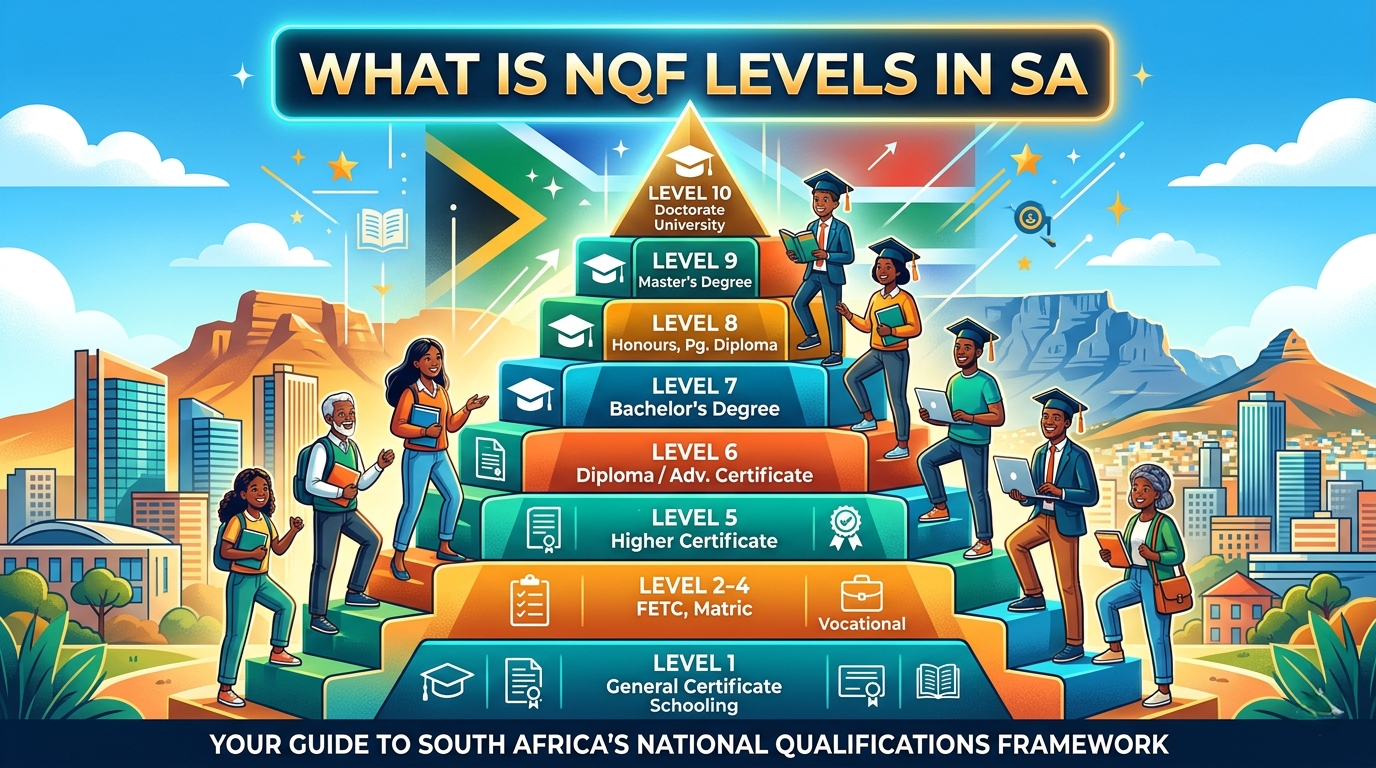
Think of it like a ladder. Each step (or level) is higher than the one before it. The higher you climb, the more skills and knowledge you have — and the more opportunities become available to you.
The NQF was established under the South African Qualifications Authority (SAQA), a government body that ensures every registered qualification meets national standards. SAQA is the organisation that gives a qualification its official stamp of approval.
Why does this matter to you? Because South African employers, universities, TVET colleges, and government programmes — including learnerships, bursaries, and the YES 4 Youth initiative — use NQF levels to determine who is eligible for what. Your NQF level is essentially your education “currency” in the job market.
Read: What is a Learnership and How Does It Actually Work in South Africa?
The 10 NQF Levels in South Africa Explained
The NQF consists of 10 levels divided into three main bands. Here is a complete breakdown of what each NQF level means:
| NQF Level | Qualification | Band | Credits |
|---|---|---|---|
| 1 | General Education Certificate (Grade 9) | General Education | 40 |
| 2 | Elementary Certificate (Grade 10 / NCV L2) | General Education | 40 |
| 3 | Intermediate Certificate (Grade 11 / N2) | General Education | 120 |
| 4 | National Senior Certificate – Matric (Grade 12) | FET | 120 |
| 5 | Higher Certificate / N4–N6 Diploma | Higher Education | 120 |
| 6 | National Diploma / Advanced Certificate | Higher Education | 240 |
| 7 | Bachelor’s Degree / Advanced Diploma | Higher Education | 360 |
| 8 | Postgraduate Diploma / Honours Degree | Higher Education | 120 |
| 9 | Master’s Degree | Higher Education | 180 |
| 10 | Doctoral Degree (PhD) | Higher Education | 360 |
Understanding the Three NQF Bands
Band 1: General and Further Education (NQF Levels 1–4)
This band covers your school years. If you are currently in high school or have completed Matric, you fall somewhere in this band.
- NQF Level 1 = Grade 9 (General Education Certificate)
- NQF Level 2 = Grade 10 (Elementary Certificate)
- NQF Level 3 = Grade 11 (Intermediate Certificate)
- NQF Level 4 = Grade 12 / Matric (National Senior Certificate)
Your Matric certificate is an NQF Level 4 qualification. This is the minimum entry requirement for most further study and for many entry-level jobs in South Africa.
Band 2: Higher Education and TVET Qualifications (NQF Levels 5–7)
This is where your post-school journey begins. TVET colleges, universities of technology, and traditional universities all offer qualifications in this band.
- NQF Level 5 = Higher Certificate (1 year at college or university)
- NQF Level 6 = National Diploma or Advanced Certificate (2–3 years)
- NQF Level 7 = Bachelor’s Degree or Advanced Diploma (3–4 years)
For example, if you complete an N4, N5, and N6 programme at a TVET college and then do 18 months of practical workplace experience, you earn a National N Diploma, which is equivalent to NQF Level 5 or 6, depending on the field.
Band 3: Advanced Degrees (NQF Levels 8–10)
These are postgraduate qualifications offered at universities.
- NQF Level 8 = Postgraduate Diploma or Honours Degree
- NQF Level 9 = Master’s Degree (MEd, MBA, MSc, etc.)
- NQF Level 10 = Doctoral Degree (PhD) — the highest qualification in South Africa
What Are NQF Credits and Why Do They Matter?
Every NQF qualification also has a credit value. Credits measure the amount of learning required to complete a qualification.
One NQF credit = 10 notional hours of learning (including contact time, self-study, and assessments).
Credits matter because they determine whether you can:
- Progress to the next level of study
- Apply for a learnership or bursary
- Get recognition for prior learning (RPL) — where experience earned outside of school can be counted
The more credits you accumulate, the more portable and valuable your qualification becomes — both locally and internationally.
Are NQF Qualifications Recognised Internationally?
Yes — to a significant extent. South Africa’s NQF is aligned with several international qualification frameworks, which means that many SAQA-registered qualifications are benchmarked against global standards.
If you plan to work or study abroad, you may need your qualification evaluated by bodies such as:
- SAQA’s Foreign Qualifications Evaluation and Advisory Service
- The relevant professional body in your destination country
This is particularly important for professionals in fields like education, healthcare, engineering, and finance, where regulated standards apply.
How NQF Levels Help You Plan Your Career Path
One of the most powerful things about understanding the NQF is that it turns your education into a clear, step-by-step roadmap. Here is how different people can use it:
For Grade 12 Learners
Your Matric (NQF Level 4) is your foundation. It qualifies you to:
- Apply for Higher Certificate programmes (NQF Level 5)
- Enrol in a 3-year National Diploma at a TVET college (NQF Level 6)
- Apply for a Bachelor’s Degree if you meet the minimum entry requirements
- Apply for learnerships that specifically target NQF Level 4 holders
For TVET College Students
Your N4–N6 certificates and National Diploma sit at NQF Levels 5–6. This means you can:
- Apply for jobs that require a National Diploma
- Use your qualification as a stepping stone toward a Bachelor’s degree at a university of technology
- Access workplace-based learning programmes and apprenticeships
For Unemployed Job Seekers
If you are currently unemployed and looking at job adverts, always check the NQF level requirement in the job description. If an advert asks for “NQF Level 5 minimum” and you have a Matric (Level 4), you may not qualify — but that tells you exactly what to upskill toward.
Many government-funded programmes, including SETA learnerships and the Expanded Public Works Programme (EPWP), are designed for learners at NQF Level 1–4 and offer a structured path upward.
How to Check If a Qualification Is NQF-Accredited
Not all advertised courses in South Africa are legitimate. Some private colleges offer certificates that are not registered on the NQF — which means employers and universities may not recognise them.
Here is how to protect yourself:
- Visit the SAQA National Learners’ Records Database (NLRD) at saqa.org.za
- Search for the institution and qualification by name
- Check the NQF level, the credit value, and the quality assurance body listed
- Confirm the institution is accredited by the Council on Higher Education (CHE), UMALUSI, or the relevant SETA/QCTO
If a qualification is not on the NQF, do not enrol. It will not be recognised by employers, and you will waste both time and money.
Frequently Asked Questions About NQF Levels
Is NQF Level 5 the same as Matric?
No. Matric (Grade 12 / National Senior Certificate) is NQF Level 4. NQF Level 5 is one step higher — it includes Higher Certificates and N4–N6 qualifications offered at TVET colleges and higher education institutions.
Can I skip NQF levels?
In some cases, yes. For example, if you have a Matric (NQF Level 4), you can apply directly for a Bachelor’s Degree (NQF Level 7) if your marks meet the entry requirements. You do not need to complete Levels 5 and 6 first, though they remain valid pathways.
What NQF level do I need for a learnership?
It depends on the learnership. Most entry-level learnerships in South Africa require a minimum of NQF Level 4 (Matric). Some learnerships — especially in sectors like construction, agriculture, and retail — accept learners with NQF Level 3 (Grade 11). Always read the specific eligibility criteria on the advert.
Does work experience count toward NQF levels?
Yes — through a process called Recognition of Prior Learning (RPL). SAQA allows learners to have their work experience formally assessed and recognised against NQF level descriptors. This is a valuable pathway for adults who have been working for years without formal qualifications.
Your NQF Level Is Your Launching Pad
Understanding what the NQF level is — and where your qualification sits on it — is one of the most practical things you can do for your education and career.
Whether you are a Grade 12 learner trying to figure out your next step, a TVET student wanting to know your worth in the job market, a parent guiding your child, or an unemployed South African looking to upskill — the NQF is your roadmap.
Every level you complete is a step forward. Every accredited certificate you earn is a door that opens. South Africa’s education system is built to give you a pathway — no matter where you start.
Start where you are. Use what you have. Climb the ladder — one NQF level at a time.
Disclaimer: NQF information in this article is based on publicly available SAQA guidelines. For official qualification verification, visit saqa.org.za. Programme requirements may vary by institution — always confirm directly with the relevant college or university.
