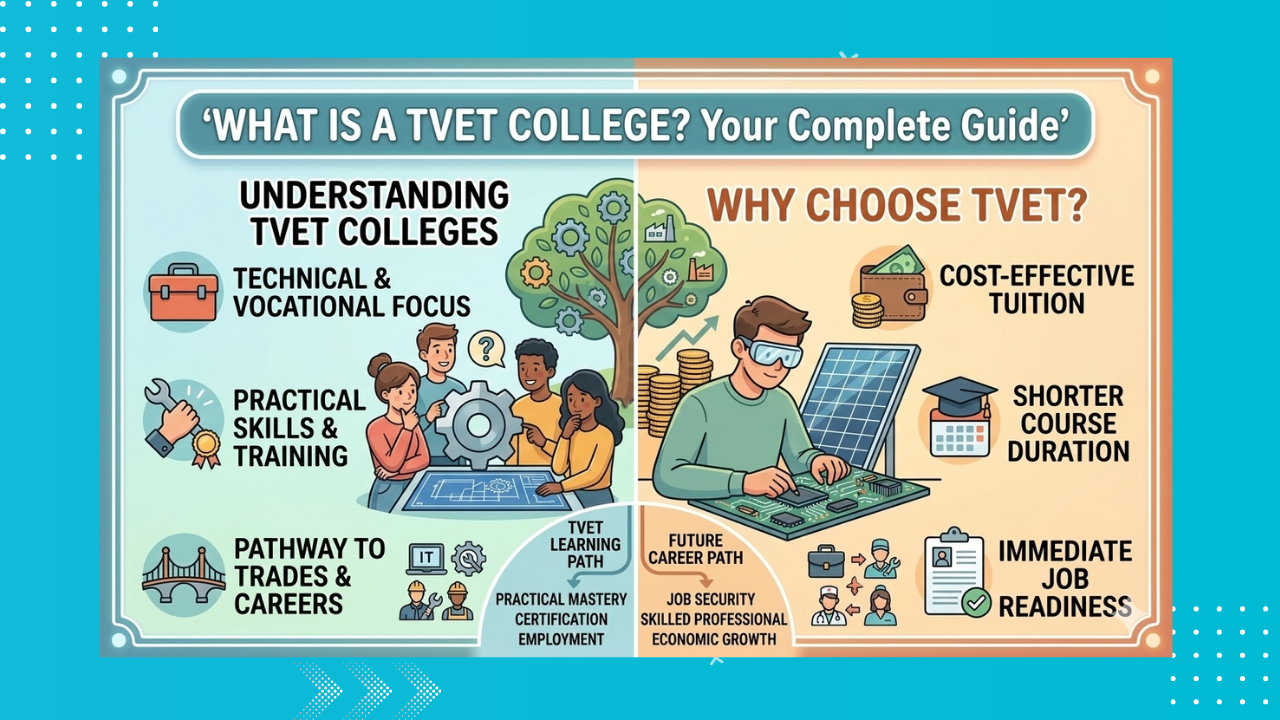
University is not the only path to a successful career. In fact, for many careers — electrician, plumber, IT technician, chef, bookkeeper — a TVET College is not just a second option. It’s the better option.
South Africa desperately needs skilled artisans and technical workers. The country has a massive skills shortage, which means TVET graduates are actively in demand. If you or your child is wondering whether TVET is the right move, this guide will give you everything you need to make a confident, informed decision.
What Is a TVET College?
TVET stands for Technical and Vocational Education and Training. A TVET College is a post-school education institution that provides practical, skills-based qualifications designed to prepare students directly for the workplace or for further study.
Unlike universities, which focus heavily on academic theory, TVET Colleges focus on doing. You learn a trade or skill by actually practising it — in workshops, labs, and real-world environments.
TVET Colleges fall under the Department of Higher Education and Training (DHET) and are regulated by Quality Council for Trades and Occupations (QCTO). This means the qualifications you earn are nationally recognised and registered on the National Qualifications Framework (NQF).
💡 Think of a TVET College as the bridge between school and a skilled, employed future — built for people who learn by doing, not just by reading.
What Qualifications Do TVET Colleges Offer?
TVET Colleges offer a range of qualifications, from short skills programmes to full diplomas. Here are the main ones:
1. National Certificate (Vocational) — NC(V)
The NC(V) is a three-year programme offered at NQF Levels 2, 3, and 4. It is equivalent to a matric certificate and can qualify you for entry into university (with the right subjects and marks).
Entry requirement: Grade 9 pass (for Level 2)
Subjects are offered across fields such as:
- Engineering & Related Design
- Finance, Economics & Accounting
- Information Technology & Computer Science
- Hospitality
- Tourism
- Primary Agriculture
2. Report 191 — NATED Courses (N1–N6)
NATED courses (also called “N courses”) follow the Report 191 curriculum and lead to National Certificates at N1 through N6 level. These programmes are split into a theory component and a practical/work experience component.
- N1–N3: Engineering Studies (e.g. Electrical, Mechanical, Civil)
- N4–N6: Business Studies (e.g. Management, Finance, Marketing, Human Resources)
To obtain a National Diploma, students must complete N4–N6 plus 18 months of relevant work experience.
Entry requirement: Grade 11 (for most N1 programmes) or Grade 12 (for N4 programmes)
3. Occupational Qualifications & Short Courses
Many TVET Colleges also offer shorter, skills-focused programmes registered under QCTO. These are ideal for adults who want to upskill quickly or re-enter the workforce.
Entry Points for TVET College
One of the biggest advantages of TVET Colleges is their flexible entry requirements. You do not need a matric certificate to start. Here is a breakdown of the entry points for TVET College:
| Qualification | Entry Requirement |
|---|---|
| NC(V) Level 2 | Grade 9 Certificate |
| NC(V) Level 3 | NC(V) Level 2 pass |
| NC(V) Level 4 | NC(V) Level 3 pass |
| N1 (Engineering) | Grade 9 or Grade 10 |
| N3 (Engineering) | Grade 11 or equivalent |
| N4 (Business/Engineering) | Grade 12 (Matric) |
| Short Courses | Varies — some require no formal qualification |
📌 This means whether you dropped out in Grade 9 or completed your matric, there is an entry point for you at a TVET College.
Why Choose a TVET College? The Real Benefits
Faster Route to Employment
Most TVET programmes take 2–3 years to complete, compared to a 3–4 year university degree. You enter the job market sooner — and start earning sooner.
Lower Cost
TVET College fees are significantly lower than university fees. Many students also qualify for NSFAS (National Student Financial Aid Scheme) funding, which can cover tuition and even living expenses. Learn more about how to apply for NSFAS (external link suggestion #1).
High Demand for TVET Skills
South Africa has a critical shortage of artisans and technical workers. Electricians, boilermakers, welders, and IT technicians are among the most in-demand professionals. A TVET qualification in these fields can lead to stable, well-paying employment.
Practical Learning
If you are someone who learns better with your hands than with a textbook, TVET is designed for you. You spend time in workshops, labs, and real workplace environments, not just classrooms.
Pathways to Further Study
Completing an NC(V) Level 4 or N6 certificate does not close the door to university. With the right subjects and marks, TVET graduates can apply for university entry. Review DHET’s articulation policy for TVET graduates (external link suggestion #2).
List of TVET Colleges in South Africa
There are 50 public TVET Colleges in South Africa, spread across all nine provinces. Below is a list of TVET Colleges in South Africa organised by province:
Gauteng
- Ekurhuleni East TVET College
- Ekurhuleni West TVET College
- Sedibeng TVET College
- South West Gauteng TVET College
- Tshwane North TVET College
- Tshwane South TVET College
- Western TVET College
Western Cape
- Boland TVET College
- Cape Peninsula University of Technology (not TVET, but often confused)
- False Bay TVET College
- Northlink TVET College
- South Cape TVET College
- West Coast TVET College
KwaZulu-Natal
- Coastal KZN TVET College
- Elangeni TVET College
- Esayidi TVET College
- Majuba TVET College
- Mnambithi TVET College
- Mthashana TVET College
- Thekwini TVET College
- Umfolozi TVET College
- Umgungundlovu TVET College
Eastern Cape
- Buffalo City TVET College
- East Cape Midlands TVET College
- Ikhala TVET College
- Ingwe TVET College
- King Hintsa TVET College
- King Sabata Dalindyebo TVET College
- Lovedale TVET College
- Port Elizabeth TVET College
Limpopo
- Capricorn TVET College
- Lephalale TVET College
- Letaba TVET College
- Mopani South East TVET College
- Sekhukhune TVET College
- Vhembe TVET College
- Waterberg TVET College
Mpumalanga
- Ehlanzeni TVET College
- Gert Sibande TVET College
- Nkangala TVET College
North West
- Orbit TVET College
- Taletso TVET College
- Vuselela TVET College
Free State
- Flavius Mareka TVET College
- Goldfields TVET College
- Maluti TVET College
- Motheo TVET College
Northern Cape
- Northen Cape Rural TVET College
- Northern Cape Urban TVET College
📌 Each college has multiple campuses. Always check the college’s official website to find the campus nearest to you and confirm which programmes are offered there.
How to Apply to a TVET College
Applying is straightforward. Here’s a simple step-by-step process:
- Choose your college — Use the list above to find one near you.
- Choose your programme — Decide between NC(V), NATED (N courses), or a short course.
- Check entry requirements — Confirm you meet the minimum entry point.
- Gather your documents — You will typically need your ID, school results (Grade 9, 11, or 12 certificate), and proof of address.
- Submit your application — Visit the campus directly or apply online through the college’s official website.
- Apply for NSFAS — If you need financial assistance, apply at the same time as your college application. Do not wait.
⚠️ Applications for some colleges open as early as August/September for the following year. Do not miss the deadline.
Common Myths About TVET Colleges — Debunked
Myth 1: “TVET is for students who failed matric.” False. TVET is a deliberate career choice. Many students with strong matric results choose TVET because it leads directly to a well-paying trade.
Myth 2: “TVET qualifications are not recognised.” False. All TVET qualifications are registered on the NQF and are recognised by the South African Qualifications Authority (SAQA) and most employers.
Myth 3: “You can’t go to university after TVET.” False. NC(V) Level 4 graduates can apply to universities and universities of technology, subject to meeting the specific entry requirements.
Myth 4: “TVET is only for technical/engineering fields.” False. TVET Colleges offer programmes in business, IT, tourism, hospitality, agriculture, and more.
Is TVET College Right for You?
Ask yourself these questions:
- Do you prefer learning by doing rather than only studying theory?
- Do you want to start working sooner rather than spending 4+ years at university?
- Are you interested in a specific trade or skill like electrical work, IT, cooking, or bookkeeping?
- Are you looking for an affordable, government-subsidised education option?
If you answered yes to any of these, a TVET College could be exactly the right fit.
Final Thoughts
TVET Colleges are not a consolation prize. They are a powerful, government-backed pathway to skilled employment — and South Africa needs more people to take this route. Whether you’re a Grade 12 student figuring out your next step, a parent guiding your child, or someone looking to re-skill as an adult, TVET offers a real, recognised, and rewarding path forward.
The question isn’t whether TVET is good enough. The question is: are you ready to build a career that South Africa actually needs?
This article is intended for informational purposes. Programme offerings and entry requirements may vary by college. Always confirm directly with your chosen institution.
