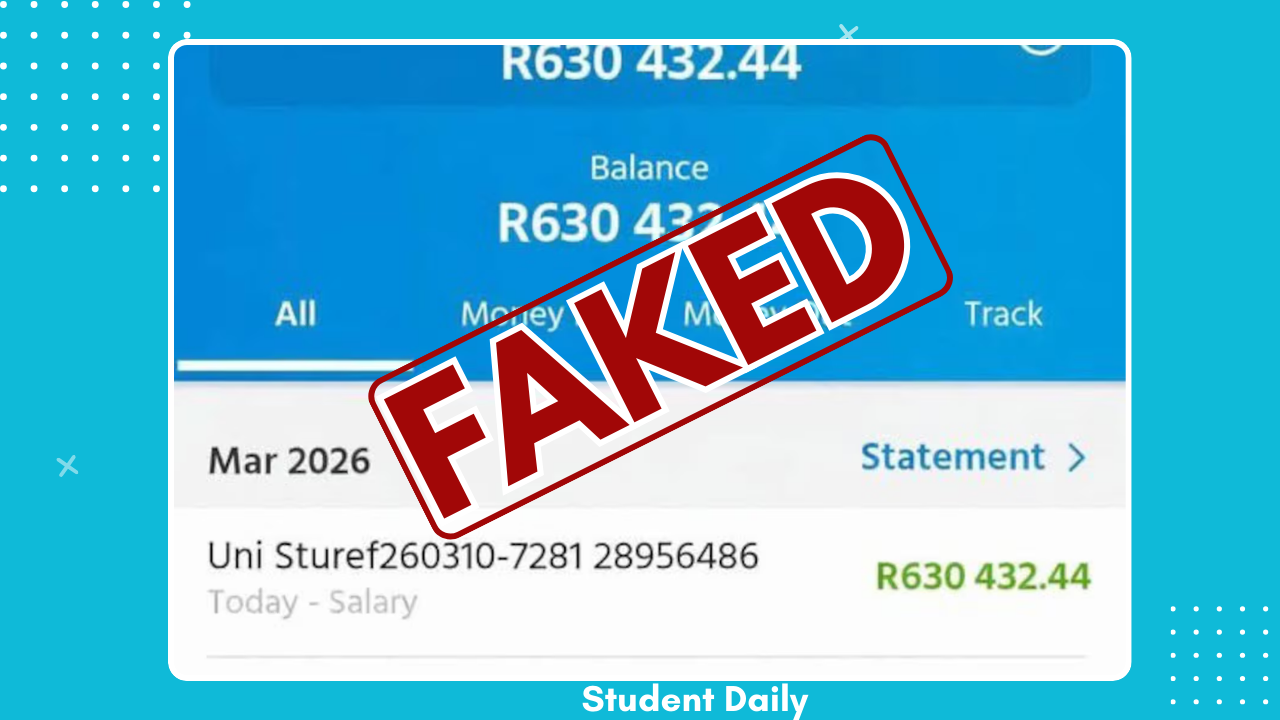
If you were anywhere near social media in the past week, you probably came across a screenshot that left a lot of people with their jaws on the floor. A payment notification — apparently from NSFAS — showing a deposit of R630,434.44 going into one student’s account. Not R6,300. Not R63,000. Six hundred and thirty thousand rand. It spread like fire, and before long, the whole country had something to say about it.
Where an how the NSFAS R630,434 Started
The image first appeared on X (formerly Twitter) around 15 March 2026, posted by a user, with a caption suggesting that NSFAS had mistakenly sent R630,432 to a student instead of R6,000 — and that the student had sent it back. That framing alone made it feel believable. It wasn’t someone claiming to be rich. It was someone doing the “right thing.” The story had a moral to it, which is exactly what makes content like this travel fast.
From X, the screenshot jumped to WhatsApp groups, Facebook pages, and TikTok — with each share adding a new layer of commentary, assumption, and outrage. Some people shared it as a warning. Others shared it as proof that NSFAS is chaotic. Some shared it simply because they had never seen a number that big attached to a student funding story.
The aim of the image, as NSFAS later revealed, was not actually about the money at all. It was about attention. The student behind it was reportedly after social media traction — views, engagement, possibly monetisation. And it worked. Just not in the way they expected.
How did people responds.
The reactions were all over the place, and honestly, that says a lot about where South African students are emotionally right now.
A big portion of people believed it — at least initially. And the reason makes sense. South Africans already know that NSFAS has a history of payment errors. Back in 2017, a Walter Sisulu University student named Sibongile Mani received R14 million by mistake and spent over R800,000 before anyone noticed. She was later convicted and sentenced to five years in prison. So when the R630,000 screenshot came up, people’s first instinct wasn’t to question it — it was to say, “This again.”
One user, responded directly with: “I would send it back as well, not after what happened to that girl.” The Mani case is still fresh in people’s minds, and it gave this hoax a ready-made layer of believability.
But the reaction that hit hardest wasn’t about whether the money was real. It was about how quickly NSFAS responded. Students who have been waiting months for their own legitimate funding — some unconfirmed, some stuck in appeals — were furious. One widely-liked comment put it plainly: “The way you were so quick to address this. I wish the same energy could be applied in resolving student issues.” Another user, pushed back on NSFAS altogether: “Even if it were true, you would not admit it.“
That is the emotional weight behind all of this. The hoax itself faded quickly once the facts came out. But it cracked open a frustration that has been building for a long time — and that part did not go away.
NSFAS R630,434 Claim false on Image.
On 16 March 2026, NSFAS issued an official statement through the South African Government communications platform. They were direct about it. The claim, they said, is “false and misleading.” Preliminary checks confirmed that the image circulating online had been manipulated and appeared to be AI-generated, with no corresponding transaction in any NSFAS record.
“No such payment has been made by NSFAS. The student in question created this content for social media purposes, likely to gain traction as part of content creation opportunities on platforms.“
— NSFAS Official Statement, 16 March 2026
NSFAS clarified something important that many people get wrong: NSFAS does not send large lump-sum payments to students directly. Funding goes to universities first, and then universities distribute allowances to qualifying students according to set guidelines. A deposit of R630,000 landing in one student’s account is simply not how the system works — and technically cannot happen under current payment structures.
As for consequences — NSFAS made it clear they are not laughing this off. The scheme warned that it “reserves the right to pursue appropriate legal action against individuals who deliberately create or distribute misinformation that harms the reputation and integrity of the Scheme.” Whether formal charges are filed remains to be seen, but the warning is on record.
Final Take
So here is where we land. A student created a manipulated image — most likely using AI tools — showing a fake R630,000 NSFAS deposit, and posted it online for engagement. It worked. Within days it was national news, government bodies were responding, and every major outlet in the country had covered it.
The image was fake. NSFAS confirmed it. The payment never happened. No system was breached, and no student received that money.
But the fact that millions of South Africans paused and considered — even for a moment — that it could be real, tells you something important about the trust gap between students and the institutions meant to support them. The hoax spread not because people are gullible, but because years of funding delays, unanswered appeals, and administrative failures have made almost anything feel possible.
Disclaimer: This article is a news report based on verified public statements and media coverage. The identity of the students and comments involved has been withheld deliberately pending any formal legal proceedings. Student Daily does not endorse or encourage the sharing of manipulated images or financial misinformation. This article is intended for informational and educational purposes only. Always verify NSFAS-related information through official NSFAS website at nsfas.org.za, and their official social media.
