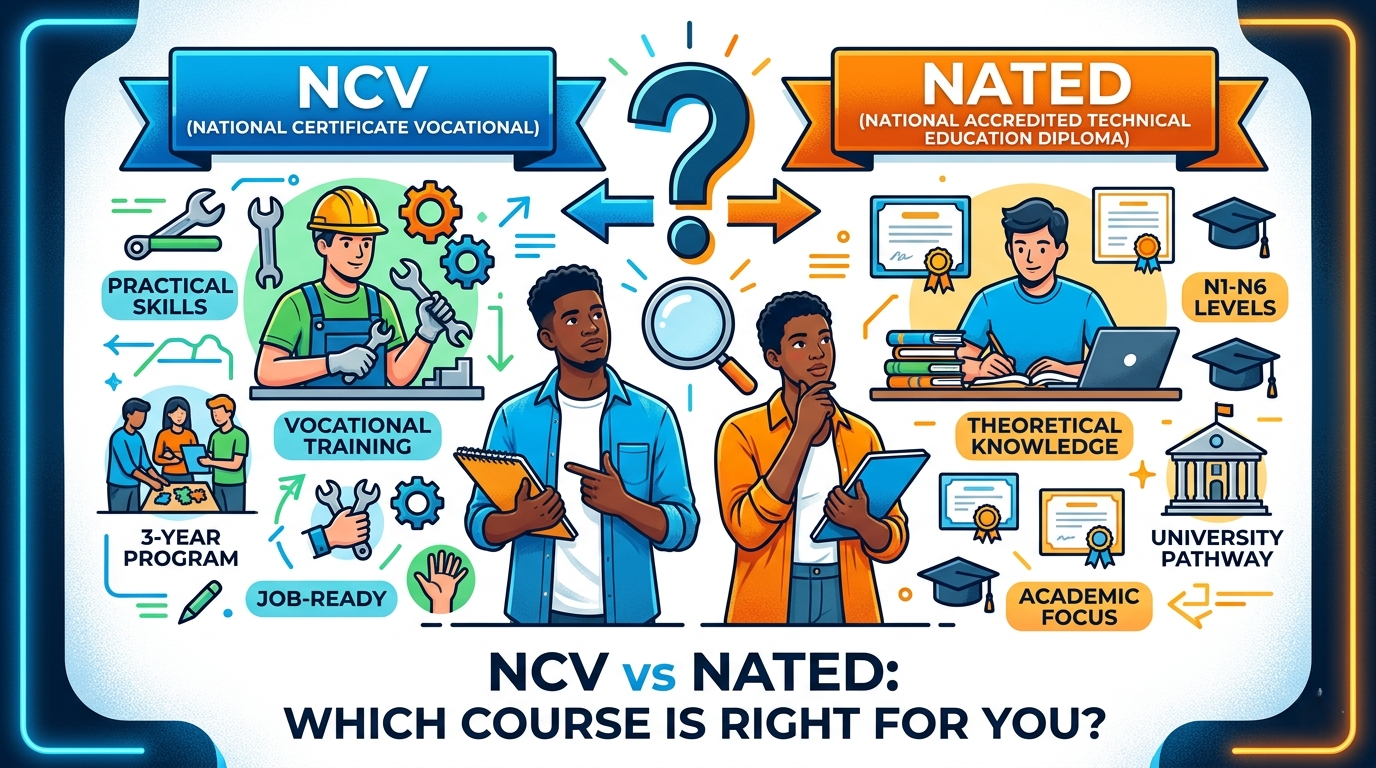
You have finished Grade 9 — or maybe you have just written your Matric exams. Everyone around you keeps asking: “What are you going to study?” You hear about TVET colleges, you hear about NCV and NATED, and suddenly it feels like you are drowning in confusing acronyms.
This is the reality for thousands of South African learners every year. Choosing the wrong qualification can cost you years of your life — and in a tough job market, that is time you simply cannot afford to waste.
The confusion between NCV and NATED courses is real. Both are offered at TVET colleges. Both promise career skills and a qualification. But they are fundamentally different in terms of who they are designed for, what they lead to, and how long they take.
What Is the NCV Qualification?
The National Certificate Vocational (NCV) is a qualification introduced by the Department of Higher Education and Training (DHET) in 2007. It was designed as a practical, skills-based alternative to the traditional school system for learners who have completed Grade 9.
NCV at a Glance
Entry requirement: Grade 9 certificate.
Duration: Three years — NCV Level 2, Level 3, and NCV Level 4.
NQF Levels: Level 2 (equivalent to Grade 10), Level 3 (Grade 11), Level 4 (Grade 12 / Matric equivalent).
Final qualification: NCV Level 4 Certificate — officially equivalent to a Matric.
NCV courses combine theory and practical training in the same programme. This means you are building real workplace skills from Day 1 — not just sitting in a classroom memorising textbooks.
The NCV is available in a wide range of subjects, including:
- Engineering and Related Design
- Business, Commerce and Management Studies
- Information Technology and Computer Science
- Tourism
- Hospitality
- Primary Agriculture
- Finance, Economics and Accounting
Who Should Study NCV?
The NCV is best suited for:
- Learners who have completed Grade 9 and want a practical, hands-on alternative to finishing high school.
- Students who struggle in a traditional classroom environment but thrive when learning vocational skills.
- Young people who already know which career field they want to pursue.
- Anyone who wants a Matric-equivalent qualification while gaining job-ready skills at the same time.
What Is the NATED Qualification?
NATED — which stands for National Accredited Technical Education Diploma — is a post-school qualification. Also known as Report 191 programmes, NATED courses are designed for students who have already completed their Matric (or NCV Level 4) and want to specialise in a specific career field.
NATED programmes are highly respected by South African employers, especially in engineering and business fields. They combine in-depth theoretical knowledge with practical workplace experience.
NATED at a Glance
Entry requirement: Matric certificate (NSC) or NCV Level 4.
Structure: Three levels of theory — N4, N5, and N6 certificates — followed by 18 months of approved practical work experience.
NQF Level: N4–N6 certificates sit at NQF Level 5 (equivalent to a Higher Certificate).
Final qualification: N6 Certificate + 18 months practical work experience = National N Diploma (NQF Level 6).
NATED courses are broken into two streams:
- Engineering Studies (N1–N6): Covers fields like Electrical Engineering, Mechanical Engineering, Civil Engineering, and more.
- Business Studies (N4–N6): Covers Financial Management, Human Resource Management, Marketing, Public Administration, and more.
Who Should Study NATED?
NATED is best suited for:
- Matric graduates who want a career-specific qualification without a full three-year university degree.
- NCV Level 4 completers who want to specialise further in their chosen field.
- Students who are focused on entering the workforce in a specific technical or business role.
- Anyone who wants a National Diploma at NQF Level 6 — a highly regarded qualification by South African employers.
NCV vs NATED: Side-by-Side Comparison
Use the table below to understand the difference between NCV and NATED at a glance.
| Feature | NCV | NATED |
| Full Name | National Certificate Vocational | National Accredited Technical Education Diploma |
| Entry Requirement | Grade 9 certificate | Matric / NCV Level 4 |
| Duration | 3 years (Level 2–4) | 18 months theory + 18 months practical |
| NQF Level | Levels 2–4 (up to Matric equivalent) | Level 5 (N4–N6 = Higher Certificate equivalent) |
| Qualification | NCV Level 4 Certificate | N6 + 18 months = National N Diploma (NQF 6) |
| Best For | Grade 9–10 learners; school alternative | Matric holders; career specialisation |
| University Access | Possible with NCV Level 4 (conditions) | Possible via University of Technology |
| NSFAS Eligible | Yes | Yes |
| Accreditation | DHET / Umalusi | DHET / Umalusi / QCTO |
Understanding NQF Levels: Why They Matter
The National Qualifications Framework (NQF) is South Africa’s system for ranking all educational qualifications from Level 1 to Level 10. Understanding where your qualification sits on this framework is crucial — it determines what jobs you qualify for and whether you can progress to further study.
Read More on What is NQF Levels in SA Education and Career System?
NCV courses sit at NQF Levels 2–4, meaning the highest you can reach with NCV is equivalent to Matric (NQF Level 4).
NATED N4–N6 certificates sit at NQF Level 5. Once you complete your N6 and the required 18 months of work experience, you earn the National N Diploma at NQF Level 6 — the same level as a three-year university diploma. This is a significant career advantage.
NSFAS Funding: Can You Get Financial Aid?
One of the most important questions for any South African student is: “Can I afford this?” The good news is that both NCV and NATED programmes at public TVET colleges are eligible for NSFAS (National Student Financial Aid Scheme) funding.
NSFAS covers registration fees, tuition fees, and a monthly allowance for qualifying students. To qualify, you must:
- Be a South African citizen.
- Come from a household with a combined income of R350,000 or less per year.
- Be a first-time entering undergraduate student.
- Be enrolled at a public TVET college.
Read: How NSFAS allowances are paid to TVET students
NCV or NATED: Which Course Should You Choose?
Now that you understand the difference between NCV and NATED, the big question is: which is right for you? Here is a simple guide based on your current situation.
Choose NCV If…
- You have completed Grade 9 but have not yet done Matric.
- You want a practical alternative to finishing high school in a traditional school.
- You are interested in a specific vocational field like Hospitality, IT, or Engineering.
- You want to earn a Matric-equivalent certificate while building real workplace skills.
- You are considering further study — NCV Level 4 gives you entry into NATED or, in some cases, university programmes.
Choose NATED If…
- You have already completed Matric or NCV Level 4.
- You want to specialise in a specific career field at a higher qualification level.
- You are targeting a National N Diploma (NQF Level 6) — one of the most respected TVET qualifications in South Africa.
- You want a qualification that combines theoretical study with 18 months of real-world work experience.
- You are aiming for employment in sectors like engineering, financial management, human resources, or public administration.
PRO TIP:
If you have completed NCV Level 4, you can transition directly into NATED N4 programmes.This means your NCV qualification is not a dead end — it is a strong foundation for further specialisation.Many TVET colleges will grant you credits for relevant NCV subjects when you enrol in NATED.
Career Opportunities After NCV and NATED
Careers After NCV
After completing NCV Level 4, graduates can pursue entry-level roles in their chosen field or continue studying. Common career paths include:
- Junior IT Technician or Help Desk Support (IT & Computer Science NCV)
- Administrative Assistant or Junior Clerk (Business NCV)
- Junior Chef or Food Service Worker (Hospitality NCV)
- Tourism Guide or Travel Agent Assistant (Tourism NCV)
- Self-employment opportunities in their vocational trade
Careers After NATED
NATED graduates — especially those with a National N Diploma — are highly employable. Career options include:
- Electrical or Mechanical Engineer (Engineering NATED)
- Financial Manager or Accountant (Financial Management N6)
- Human Resources Officer (HRM N6)
- Marketing Manager (Marketing Management N6)
- Public Administrator (Public Administration N6)
- Further study towards a Bachelor’s degree at a University of Technology
3 Common Mistakes Students Make When Choosing
Mistake 1 — Enrolling in NATED without Matric: NATED N4–N6 requires a Matric or NCV Level 4. Without it, you cannot legally enrol. Start with NCV if you haven’t yet completed high school.
Mistake 2 — Assuming NCV Level 4 automatically gets you into university: NCV Level 4 is a Matric equivalent — but universities have specific subject and mark requirements. Always check with the institution before assuming you qualify.
Mistake 3 — Forgetting about the 18-month practical requirement for NATED: Many students complete their N6 and then realise they still need 18 months of approved work experience to earn the National N Diploma. Plan for this from Day 1 — start applying for workplace exposure while still studying.
Your Future Starts With the Right Choice
Both NCV and NATED are legitimate, government-accredited pathways to a successful career in South Africa. They are not in competition with each other — they serve different purposes at different stages of a student’s journey.
NCV is your starting point if you are building from Grade 9, want practical skills, and need a Matric-equivalent certificate. NATED is your next step if you have your Matric and want to specialise, go deeper, and earn a National Diploma that employers respect.
The most important thing is that you take action. South Africa’s economy needs skilled, qualified workers — and TVET colleges exist to give you exactly that. Whether you choose NCV or NATED, you are making a powerful investment in your future.
Do not let confusion stop you from starting. Now that you understand the difference between NCV and NATED, you have the knowledge to make a confident decision. Go get it.
Disclaimer: This article is intended for informational purposes only. Entry requirements, NQF levels, and NSFAS eligibility criteria may change. Always verify the most current information directly with the DHET (www.dhet.gov.za), your TVET college, and NSFAS (www.nsfas.org.za) before applying.
