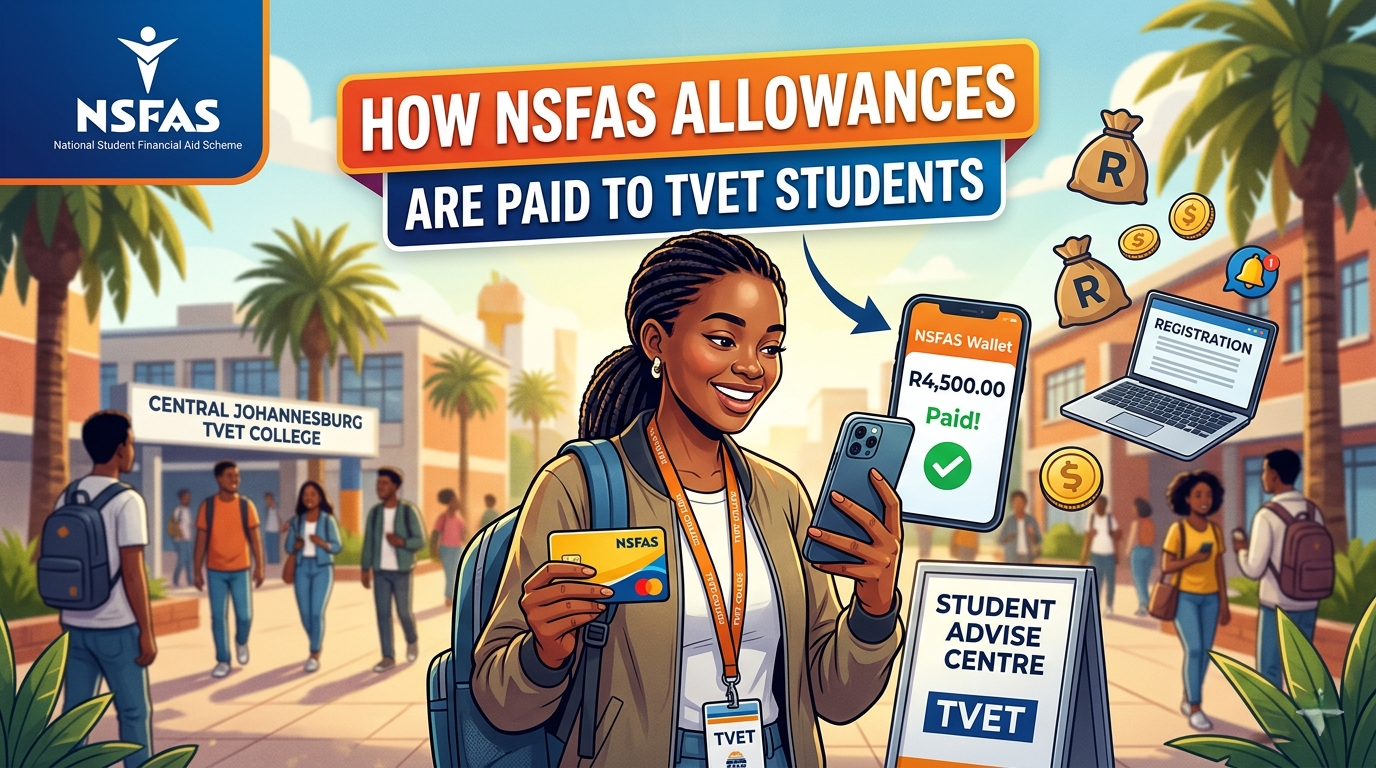
NSFAS approves funding, but many students don’t fully understand how NSFAS allowances are actually paid to TVET students — and that knowledge gap causes panic, confusion, and unnecessary hardship.
The good news? The payment system is not as complicated as it seems. Once you understand how it works, you can plan ahead, avoid delays, and know exactly when your money will arrive. This guide breaks it all down — simply, clearly, and completely.
The National Student Financial Aid Scheme (NSFAS) is a South African government programme that provides financial support to students from low-income households who want to study at public universities and TVET (Technical and Vocational Education and Training) colleges.
NSFAS does not just pay your tuition. For TVET students, it also pays a range of monthly living allowances to help you cover the real costs of studying — food, transport, accommodation, books, and personal care.
How NSFAS Allowances Are Paid to TVET Students
This is the most important section of this article. Understanding how NSFAS allowances are paid to TVET students can save you weeks of stress and confusion.
Step 1: Your College Submits Your Registration Data
Everything starts with your TVET college submitting your registration data to NSFAS. NSFAS does not know you are enrolled until your college uploads your information to the NSFAS portal.
This is the most common cause of payment delays. If your college is slow to upload registration data, your payment is pushed to the next payment run. That is why it is important to register early and follow up with your college’s Financial Aid Office.
Step 2: NSFAS Verifies Your Banking Details
Since 2025, NSFAS has moved to a direct payment system — meaning allowances are paid straight into your personal bank account, not through your college or a third party.
For this to work, you must:
- Log in to your myNSFAS portal at www.nsfas.org.za
- Capture and verify your banking details accurately
- Ensure your ID details and contact information are correct
NSFAS will not make payments to third-party accounts or to your college account. The money goes directly to you.
Step 3: NSFAS Releases the Payment
Once your college has submitted valid registration data and your banking details are confirmed, NSFAS releases your allowance on the official payment date for that cycle.
For 2026, the key confirmed payment dates for TVET students have been:
- 13 February 2026 — First direct allowance disbursement to TVET students
- 27 February 2026 — Second disbursement for students whose colleges submitted data after the first cut-off
- 7 March 2026 — Payment run for students whose colleges submitted data by 4 March 2026
- 14 March 2026 — Additional run for data submitted by 10 March 2026
- 25th of every month from April 2026 — Regular monthly allowance for all qualifying TVET students
Source: Official NSFAS statements and SA Government communications (gov.za), February–March 2026.
Read: How to Apply for NSFAS (Step-by-Step) Guide for TVET Students
What Amount Do TVET Students Receive From NSFAS?
As a funded TVET student, you may qualify for several different types of allowances, depending on your situation — where you live, how far your college is, and what programme you are enrolled in.
Below is a breakdown of the 2026 NSFAS allowances for TVET students, based on the latest Department of Higher Education and Training (DHET) guidelines:
| Allowance Type | Amount Per Year | Notes |
| Accommodation (Urban) | Up to R24,000 | For students in towns/cities |
| Accommodation (Peri-Urban) | Up to R18,900 | Semi-urban areas |
| Accommodation (Rural) | Up to R15,750 | Rural areas |
| Transport | Up to R7,350 | Up to 40km from college |
| Books / Learning Materials | Up to R5,200 | Paid at semester start |
| Personal Care (Incidental) | Up to R2,900 | For daily incidentals |
| Living/Meal Allowance | R16,500 (approx) | Approx. R1,650/month x 10 |
Note: The 2026 allowance rates are currently under final review, informed by consumer price inflation and the national budget. The 2025 living allowance was R17,160 per year. Updated 2026 rates will be confirmed once finalised by DHET.
On average, a TVET student receiving accommodation, transport, and living allowances can expect to receive between R3,000 and R5,500 per month, with students in metro areas typically receiving more.
Why Is My NSFAS Payment Delayed? Common Reasons
Even if you are approved for NSFAS, your allowance can still be delayed. Here are the most common reasons — and what you can do about each one:
| Common Causes of NSFAS Payment Delays for TVET Students |
| Your college did not upload your registration data by the cut-off date |
| Your banking details on the myNSFAS portal are incorrect, outdated, or unverified |
| Your NSFAS application is still showing ‘Awaiting Registration Data’ |
| You have outstanding documents that NSFAS still needs from you |
| You failed too many modules and your funding has been suspended |
| You enrolled at a private college (NSFAS only funds public TVET colleges) |
What to do: Log in to your myNSFAS portal at www.my.nsfas.org.za, check your status, and visit your college Financial Aid Office as soon as possible if there is a problem.
What About Accommodation Allowances?
Accommodation is one of the biggest concerns for TVET students. Here is how it works in 2026:
- If you live in on-campus accommodation, NSFAS pays your residence directly
- If you live in private (off-campus) accommodation, the landlord must be NSFAS-accredited and must have submitted verified banking details
- If you live at home with parents/guardians, you will likely receive a transport allowance instead of an accommodation allowance
The accommodation cap for TVET students in 2026 ranges from R15,750 to R24,000 per year, depending on whether you are in a rural, peri-urban, or urban area. NSFAS will not pay above the cap, even if your actual rent is higher.
How to Make Sure You Receive Your Allowance on Time
Here are practical steps every TVET student should take to avoid delays:
- Register at your TVET college as early as possible — this ensures your data is in the system before cut-off dates
- Log in to your myNSFAS portal and make sure your banking details are correct and verified
- Keep your personal information updated — your ID number, contact number, and email address
- Follow up with your college Financial Aid Office to confirm your registration data has been submitted to NSFAS
- Attend class and pass your modules — failing too many subjects can cause NSFAS to suspend your funding
- Do not share your banking details with anyone — NSFAS will never ask for your PIN or password
Advice for Grade 12 Learners and Parents
If you are a Grade 12 learner or a parent helping a child plan for further education, here is what you need to know about NSFAS and TVET allowances:
- NSFAS applications for 2027 typically open in August/September 2026 — apply as early as possible
- Gather key documents in advance: ID documents, proof of income (or SASSA grant documentation), and the student’s ID or birth certificate
- NSFAS funds all 50 public TVET colleges across South Africa
- Students with disabilities may qualify for additional support for equipment, human assistance, and medical assessments
- Once funded, your child must meet academic progression requirements to keep receiving allowances
Frequently Asked Questions About NSFAS TVET Allowances
Can NSFAS pay my allowance into someone else’s account?
No. NSFAS pays allowances directly into your personal bank account only. Third-party payments are not allowed.
What happens if my college misses the data upload deadline?
Your payment will be delayed to the next payment run. Contact your college Financial Aid Office immediately and ask them to prioritise your registration upload.
Does NSFAS pay the same amount every month?
Most allowances are paid monthly in equal amounts throughout the academic year. Book allowances are typically paid as a lump sum at the start of each semester.
What if my NSFAS application was rejected?
You have the right to appeal. You have 30 days from the date of your outcome notification to lodge an appeal and submit supporting documents through the myNSFAS portal.
Do TVET students at private colleges qualify for NSFAS?
No. NSFAS only funds students enrolled at public TVET colleges. Students at private colleges do not qualify.
Final Thoughts: Knowledge Is Your Greatest Advantage
Understanding how NSFAS allowances are paid to TVET students is not just useful — it is essential. When you know the steps involved, you can take action early, avoid delays, and focus on what truly matters: building the skills and qualifications that will shape your future.
NSFAS paid over R4.2 billion to institutions at the start of 2026 — including R679 million for TVET tuition. The system is working. But it works best for students who are informed, prepared, and proactive.
Register early. Check your portal. Follow up with your college. And never stop pushing forward.
You deserve this opportunity. Make the most of it.
DISCLAIMER: This article is intended for informational purposes only. NSFAS allowance amounts and payment dates are subject to change based on annual government budget allocations. Always verify current information at the official NSFAS website: www.nsfas.org.za or by contacting the NSFAS Virtual Contact Centre.
