You’re sitting with your matric results, a university acceptance letter — and absolutely no idea how you’re going to pay for it all. Sound familiar?
Millions of Grade 12 students and their parents face this exact moment every year. The cost of tertiary education keeps climbing, and the window to apply for funding feels impossibly short. You’ve probably heard people talk about bursaries and student loans — but nobody seems to explain what they actually mean or which one you should be chasing.
Here’s the hard truth: choosing the wrong funding option could cost you thousands — or leave you buried in debt before your career even starts. The difference between a bursary and a student loan isn’t just technical jargon. It could be the difference between starting your adult life financially free or spending a decade paying off an education.
In this guide, we break down everything you need to know about bursary vs student loan — in plain language, with no fluff.
Key Takeaways
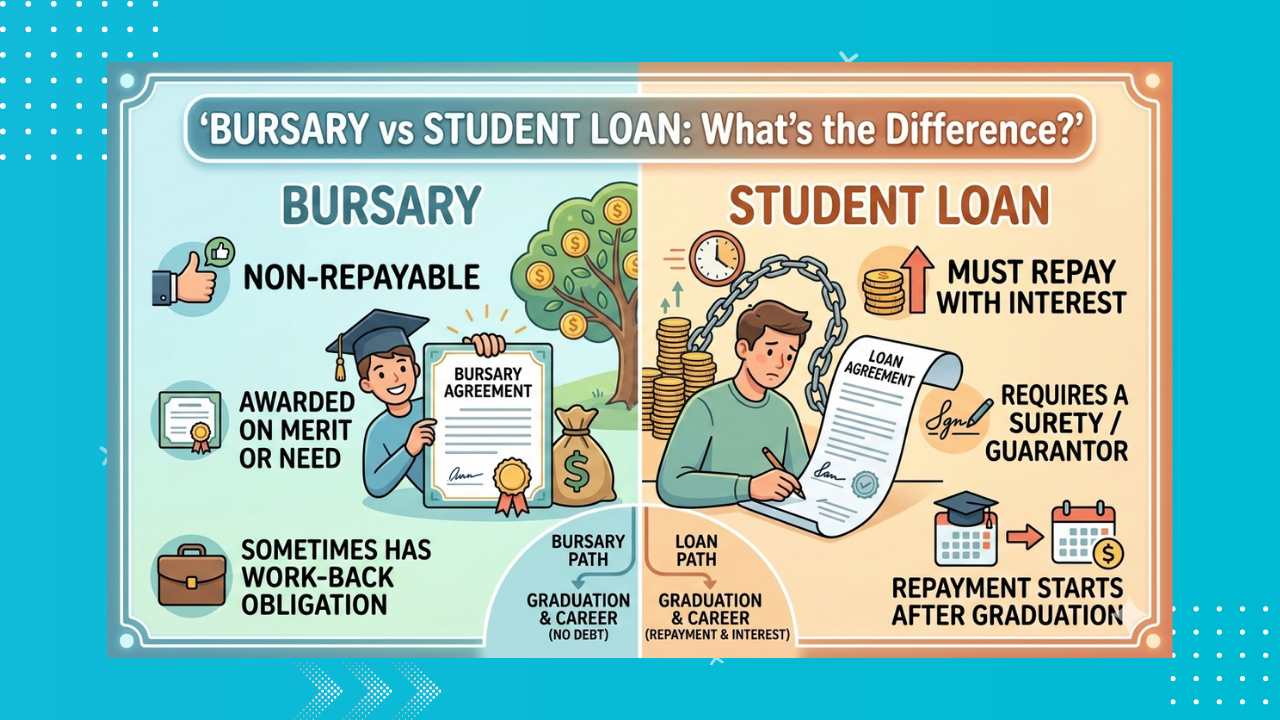
- A bursary is free money — you don’t pay it back (usually)
- A student loan is borrowed money — you must repay it, with interest
- Bursaries are often merit- or need-based and may require academic performance or working for a sponsor
- Student loans are more widely available but come with long-term financial consequences
- You can apply for both at the same time — they are not mutually exclusive
- Always exhaust bursary and scholarship options before taking a student loan
- Apply early — most bursary deadlines fall between March and August for the following academic year
What Is a Bursary?
A bursary is a financial award given to a student to help cover the cost of education. The most important thing to understand is this: you do not repay a bursary — at least not with money.
Bursaries are typically offered by:
- Government departments (e.g., NSFAS in South Africa, SAICA, SETA-funded bursaries)
- Large corporations and private companies
- Non-profit organisations and foundations
- Universities themselves (institution-specific bursaries)
Types of Bursaries
1. Need-Based Bursaries These are awarded based on financial hardship. If your household income falls below a certain threshold, you may qualify. NSFAS (National Student Financial Aid Scheme) is the most well-known example of this in South Africa. (Internal link opportunity: “How to apply for NSFAS step-by-step”)
2. Merit-Based Bursaries These reward academic achievement. Strong matric results — especially distinctions — make you a competitive candidate. Some bursaries require a minimum average of 65–80%.
3. Field-Specific Bursaries Many companies offer bursaries specifically for students studying towards scarce skills — Engineering, Accounting, IT, Teaching, and Healthcare are perennially popular fields. These often come with a work-back agreement, meaning you agree to work for the sponsoring company for a set number of years after graduating.
4. Combination Bursaries These consider both financial need and academic performance. They are among the most competitive, but also among the most generous.
What Does a Bursary Cover?
Depending on the sponsor, a bursary can cover:
- Tuition fees (the most common)
- Accommodation (residence or private housing)
- Meals and living expenses
- Textbooks and study materials
- Laptop or technology allowance
Important: Read the fine print. Some bursaries only cover tuition, leaving you responsible for everything else. Always confirm what is included before accepting.
The Catch With Bursaries
There’s almost always a condition. The most common one is the work-back agreement — if a company pays for your studies, they expect you to work for them for 1–3 years after graduation. If you leave early or fail to complete your degree, you may be required to repay the full bursary amount. Always read your bursary contract carefully.
What Is a Student Loan?
A student loan is money borrowed from a financial institution — typically a bank — to pay for your education. Unlike a bursary, every cent must be repaid, usually with interest.
Student loans are offered by:
- Commercial banks (e.g., Nedbank, Standard Bank, Absa, FNB in South Africa)
- Development finance institutions
- Some government-backed loan schemes
How Student Loans Work
Here’s the basic structure of most student loan agreements:
- Application: You (or a parent/guardian as surety) apply to a bank. The bank assesses your creditworthiness.
- Approval & Disbursement: If approved, the funds are paid directly to the institution.
- Study Period: Many banks allow a grace period while you’re studying — you pay only the interest, or sometimes nothing at all.
- Repayment: Once you graduate (or leave the institution), full repayment begins. Repayment periods typically range from 5 to 15 years, depending on the amount borrowed.
Understanding Interest on Student Loans
This is where many students get caught off guard. Let’s say you borrow R50,000 at an interest rate of 11.25% per year (a typical prime-linked rate). Over a 10-year repayment period, you could end up repaying more than R80,000 in total.
Interest is the real cost of a student loan. The longer your repayment term, the more you pay. (External link opportunity: Use a student loan repayment calculator from a reputable bank or financial education site)
Who Qualifies for a Student Loan?
Most banks require:
- A parent or guardian to co-sign as surety (especially for students with no income)
- Proof of acceptance at a recognised institution
- Proof of household income (payslips, bank statements)
- A good credit record (for the surety)
Bursary vs Student Loan: Side-by-Side Comparison
| Feature | Bursary | Student Loan |
|---|---|---|
| Do you repay it? | No (or via work-back) | Yes, with interest |
| Who provides it? | Companies, government, NGOs | Banks, financial institutions |
| Availability | Competitive / Limited | Widely available |
| Application | Annual, deadline-driven | Year-round |
| Conditions | Academic/financial criteria, work-back | Credit check, surety required |
| Impact on future finances | None (if conditions met) | Monthly repayments for years |
| Covers | Varies by sponsor | Tuition + extras (at a cost) |
Key Differences Between a Bursary and a Student Loan
Understanding the difference between a bursary vs student loan goes beyond the repayment question. Here’s what really sets them apart:
1. Financial Obligation
A bursary gives you money. A student loan lends you money. This single distinction shapes your entire post-graduation financial life. Graduates with large student loan debt often delay major life milestones — buying a car, renting their own place, starting a family — because of monthly repayments.
2. Selection Criteria
Bursaries are selective. There are more applicants than awards, and competition can be fierce. You need strong academics, a compelling personal statement, or documented financial need — sometimes all three.
Student loans are more accessible. As long as you (or your surety) meet the bank’s credit criteria, you’re likely to be approved. This accessibility is both a strength and a risk.
3. Long-Term Impact
A bursary, if completed successfully, has zero long-term financial cost to the student. A student loan follows you for years. Many graduates describe the psychological burden of debt as affecting their confidence and career choices — taking “safe” jobs rather than entrepreneurial risks just to keep up with repayments.
4. Relationship With a Sponsor
A bursary often creates a professional relationship with the sponsoring company. This can be incredibly valuable — built-in work experience, mentorship, and a job on graduation day. However, it also limits your freedom to choose your own career path immediately after graduating.
Which Option Is Right for You?
There’s no single right answer — but here’s a practical framework for making the decision:
Choose a Bursary First If…
- You have strong academic results (60% average or higher)
- Your household income qualifies you for need-based funding
- You’re studying in a field with active bursary sponsors (Engineering, Accounting, IT, Education, Health Sciences)
- You’re comfortable with a potential work-back obligation
- You apply early and meet deadlines
Consider a Student Loan If…
- You’ve been rejected from or don’t qualify for available bursaries
- You’re confident in your earning potential after graduation
- The degree you’re pursuing leads to a well-paying profession
- You have a surety willing and able to co-sign
- You understand and accept the full repayment obligation
Can You Get Both?
Yes — and many students do. A partial bursary covering tuition, combined with a smaller student loan for accommodation and living expenses, is a common and practical arrangement. Just be careful not to borrow more than you genuinely need.
Practical Tips for Applying
For Bursaries:
- Start researching in Grade 11 — many applications open early in the year
- Keep your academic records updated and certified
- Write a strong, personal motivation letter — be specific, not generic
- Apply to multiple bursaries simultaneously
- Check company websites, the National Bursary Database, and university financial aid offices (External link opportunity: official national bursary database or government DHET portal)
For Student Loans:
- Compare interest rates across at least 3 banks before committing
- Understand the total repayment cost, not just the monthly instalment
- Ask about interest-free grace periods during your studies
- Keep borrowing to the absolute minimum you need
- Maintain communication with your bank if you struggle to repay after graduation — many offer restructured repayment plans
A Note for Parents
If you’re a parent reading this: your involvement matters enormously. Most student loans require a parent or guardian as surety, which means your credit record is on the line. Before signing anything, ensure you understand the terms fully.
More importantly, encourage your child to apply for bursaries — not just as a Plan B, but as Plan A. The time investment in a bursary application is far less costly than years of loan repayments.
Final Thoughts on Bursary vs Student Loan
The bottom line is this: a bursary is almost always the better option financially, but it requires proactive effort, strong academics, and timing. A student loan is a powerful tool when used wisely and sparingly — but it comes with real consequences if mismanaged.
The smartest approach? Pursue every bursary opportunity available to you first. If a loan becomes necessary to bridge the gap, borrow only what you need, understand every condition, and have a repayment plan in place before you graduate.
Your education is an investment. Make sure the way you finance it doesn’t cancel out the returns.
