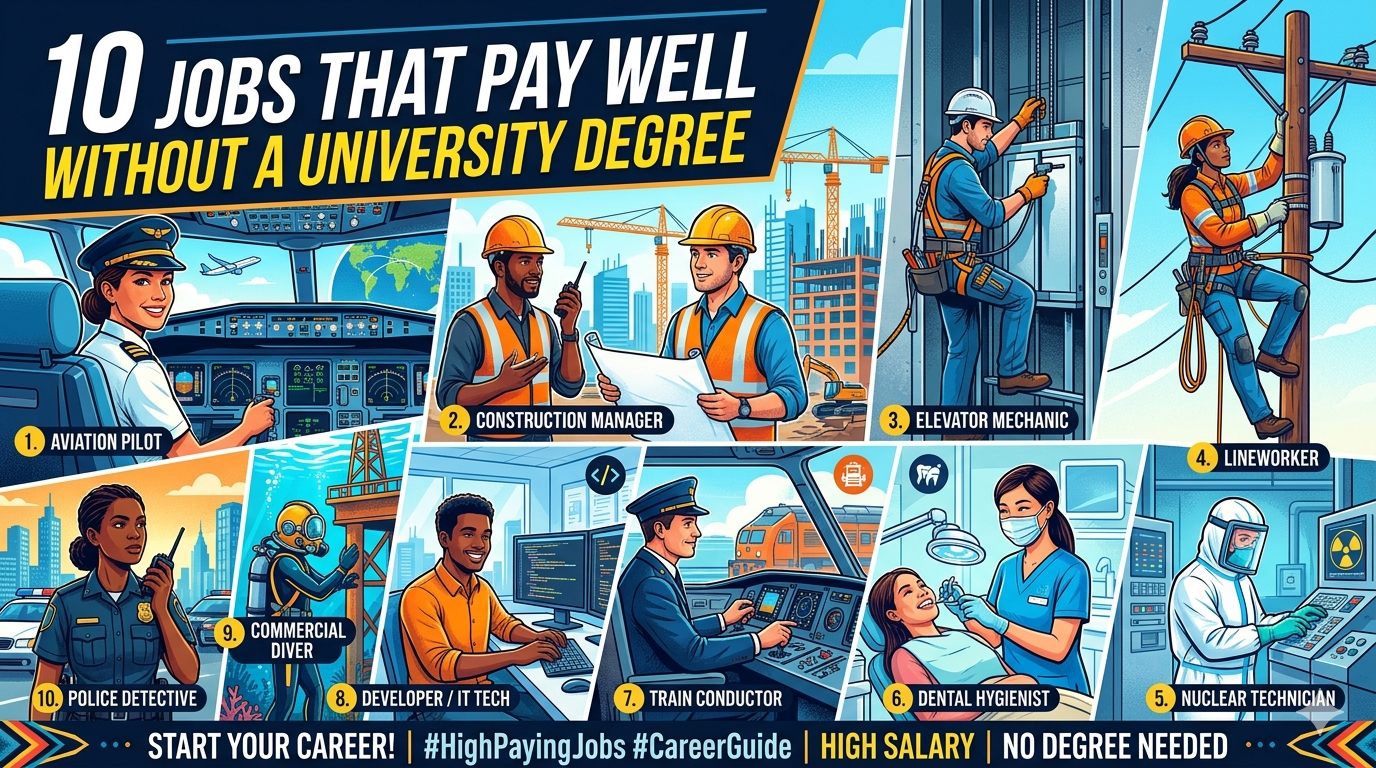
Here is the hard truth: millions of young people are told that a university degree is the only path to a well-paying career. So they apply. They borrow money. They spend three to four years studying — and sometimes graduate into a job market that doesn’t have room for them.
The pressure is real. Parents worry. Students feel stuck. And the unemployment line keeps growing.
But here is what the career guides don’t always tell you: some of the best-paying and fastest-growing jobs in the world do not require a university degree at all.
Skilled trades, technology, healthcare support, transportation — these fields are actively hiring, paying competitive salaries, and offering career growth to people who are willing to learn a skill, complete a short training programme, or earn a certification.
This article breaks down 10 high-paying jobs that don’t require a university degree, how to get into each one, and what you can realistically earn. Whether you are finishing Grade 12, enrolled at a TVET college, or are a parent trying to guide your child — this guide is for you.
Quick Stat:
According to the U.S. Bureau of Labor Statistics (BLS), many non-degree careers now offer median salaries well above $60,000 per year — with some topping $100,000. The same skills-based shift is happening globally, including in South Africa.
Why Skills-Based Hiring Is on the Rise
The job market has shifted. Companies like Google, Apple, and IBM have publicly removed degree requirements for many of their entry-level and mid-level positions. Employers are increasingly asking one question above all others: Can you do the job?
This shift toward skills-based hiring means that certifications, apprenticeships, vocational training, and hands-on experience now carry real weight — often as much as a degree, and sometimes more.
For Grade 12 learners in South Africa, this is encouraging news. Your Matric certificate is a valid starting point for many of the careers listed below. TVET colleges, learnerships, and short courses can get you job-ready in months — not years.
Three reasons why non-degree careers are worth considering:
- No student debt. You enter the workforce earning, not paying back loans.
- Faster entry. Many programmes take 6 to 24 months, not 3 to 4 years.
- Real demand. Skilled trades and technical roles face serious shortages globally and locally.
At a Glance: Top Jobs That Pay Well Without a University Degree
Salary figures sourced from the U.S. Bureau of Labor Statistics (BLS) Occupational Outlook Handbook, 2024–2026 data. Figures reflect median annual salaries in USD and serve as global benchmarks.
| Job Title | Entry Path | Median Salary (USD) | Job Growth |
| Elevator Installer & Repairer | Apprenticeship (4 yrs) | $106,580 | 5% growth |
| Air Traffic Controller | FAA Training + HS Diploma | $144,580 | Stable |
| Commercial Pilot | Flight School + Licence | $122,670 | Growing |
| Electrical Power-Line Installer | Vocational + Apprenticeship | $92,560 | 7% growth |
| Electrician | Trade School / Apprenticeship | $65,000+ | 10% growth |
| Plumber | Apprenticeship / Trade School | $61,000+ | 2% growth |
| HVAC Technician | Trade School / Certification | $60,000+ | 6% growth |
| Aircraft Mechanic | FAA A&P Certification | $79,140 | 5% growth |
| Web Developer | Bootcamp / Self-taught | $84,960 | 16% growth |
| Dental Hygienist | 2–3 Year Diploma + Licence | $81,360 | 9% growth |
1. Skilled Trades: High Demand, High Income
Skilled trades are the backbone of every functioning economy. Yet fewer young people are entering these fields — and that shortage is exactly what makes them so valuable right now.
Electrician
What they do: Electricians install, maintain, and repair electrical wiring systems in homes, businesses, and industrial settings.
How to enter: Complete a trade school programme or apprenticeship. In South Africa, you can complete a TVET college electrical trade qualification or register for an Eskom learnership.
What you can earn: Median salary of $65,000+ internationally. In South Africa, experienced electricians earn between R250,000 and R600,000+ per year depending on specialisation.
- No degree required — a trade certificate and Matric are the main entry requirements.
- Electrification trends (solar, EVs, smart homes) are creating consistent new demand.
- Union membership often boosts pay by 20–30%.
Plumber
What they do: Plumbers install and maintain piping systems for water, gas, and sewage in residential and commercial properties.
How to enter: Apprenticeship or TVET college trade programme. The National Artisan Development Programme in South Africa supports plumbing trade training.
Earning potential: Median $61,000+ globally. In South Africa, registered plumbers earn R180,000 to R450,000 per year — more in remote or industrial projects.
- Plumbing issues are urgent and unavoidable — demand never disappears.
- Registered plumbers can also run their own businesses.
HVAC Technician
What they do: HVAC technicians install and service heating, ventilation, and air conditioning systems. It is technical work with year-round demand.
How to enter: Trade school or certification programme. Typically 6–18 months.
Earning potential: Median $60,000+ globally. Growing 6% through 2034 according to BLS data.
- One of the most recession-resistant trades — buildings always need climate control.
- Clean energy regulations are creating new HVAC specialisations.
2. Technology Roles:
Technology has become the most democratised industry on the planet. You can teach yourself to code, build a portfolio, complete an online bootcamp, and land a paying job — all without a university degree.
Web Developer
What they do: Web developers design, build, and maintain websites and web applications. Front-end developers work on what users see; back-end developers manage databases and servers.
How to enter: Online bootcamps (often 3–6 months), self-study via platforms like freeCodeCamp, The Odin Project, or Coursera. Build a portfolio and start applying.
What you can earn: Median $84,960 per year globally. South African web developers earn R180,000 to R500,000+ per year, with remote work opening global rates.
- 16% job growth projected by BLS — one of the fastest-growing roles.
- Freelance and remote opportunities are abundant.
- Companies like Google and IBM have dropped degree requirements for developer roles.
Real talk: Web development rewards portfolio over pedigree. A junior developer with three strong projects on GitHub can outcompete a graduate with no practical experience.
IT Support Specialist / Computer Support Technician
What they do: These professionals help individuals and organisations troubleshoot hardware and software problems. They are the first line of technical support in any company.
How to enter: CompTIA A+ certification is the industry standard and can be achieved in 3–6 months. No degree required.
What you can earn: Median $59,660 globally. With experience and additional certifications (CompTIA Security+, Microsoft Azure), salaries grow significantly.
- Entry point for a broader IT and cybersecurity career path.
- Remote and hybrid work options are widely available in this field.
3. Healthcare Support:
You do not need to be a doctor or a nurse to build a well-paying career in healthcare. Support roles are in high demand globally, pay well, and carry real job satisfaction.
Dental Hygienist
What they do: Dental hygienists clean teeth, take X-rays, examine patients for signs of disease, and educate patients on oral hygiene.
How to enter: A 2–3 year non-degree diploma or associate programme in dental hygiene, plus licensing. TVET colleges and private health academies offer relevant programmes.
What you can earn: Median $81,360 per year globally. Growing 9% through 2034.
- Shortage of dental professionals in many regions keeps demand high.
- Stable, in-office work with predictable hours.
- Opportunity to specialise in periodontics, paediatrics, or community health.
Sterile Processing Technician (Medical Equipment Preparer)
What they do: These technicians clean, sterilise, and prepare surgical instruments and equipment in hospitals and clinics. They are essential to safe surgery.
How to enter: Certification through a sterile processing board typically takes 4–6 months.
What you can earn: Median $54,040 globally with 8% job growth. Overtime is widely available in hospital settings.
- One of the most accessible entry points into the healthcare sector.
- Hospitals compete for qualified staff, and wages are improving.
4. Transportation & Aviation:
Aircraft Mechanic & Avionics Technician
What they do: Aircraft mechanics inspect, maintain, and repair aircraft systems and engines. Avionics technicians specialise in electronic systems. These roles are critical to aviation safety.
How to enter: FAA Airframe & Powerplant (A&P) certification via an approved aviation maintenance school. Programme typically takes 18–24 months. Airlines and MRO (Maintenance, Repair & Overhaul) facilities hire directly from these schools.
What you can earn: Median $79,140 per year. Airlines are hiring aggressively through 2030 due to an ageing workforce.
- Named the #1 high-paying non-degree job by U.S. News for 2026.
- Stable, safety-critical work with strong union protections.
- South African Aviation Authority (SACAA) offers equivalent certifications locally.
Commercial Pilot
What they do: Commercial pilots operate aircraft for cargo, charter services, or aerial operations. They require a high school diploma and a commercial pilot’s licence — not a university degree.
How to enter: Flight school and licensing. Training costs are significant ($55,000–$100,000 internationally), but earning potential is high.
What you can earn: Median $122,670 per year. Air traffic controllers earn even more, averaging $144,580.
- Demand for qualified pilots is expected to grow significantly over the next decade.
- South Africa has accredited flight schools that meet SACAA requirements.
5. Construction & Infrastructure:
Elevator Installer & Repairer
What they do: These specialists install, maintain, and repair elevators, escalators, and chairlifts in residential and commercial buildings. It is precision engineering work.
How to enter: Four-year apprenticeship. Requires only a high school diploma (Matric) and mechanical aptitude.
What you can earn: Median $106,580 per year — with the top 10% earning over $149,250. Named the #1 highest-paying non-degree job in the 2026 Resume Genius report.
- Safety-critical, precision work that AI cannot easily replace.
- 5% job growth projected; high demand in urban development.
How to Start Your Career Path Without a Degree
Knowing the options is the first step. Taking action is the next. Here is a practical roadmap to move from where you are to where you want to be.
Step 1: Identify Your Interest Area
Look at the list above and ask yourself: What do I enjoy? What am I good at? Do I like working with my hands, with technology, or with people? Your answer will guide your career choice.
Step 2: Research the Entry Requirements
Every career on this list has a specific entry path. Some require a short certification. Others need an apprenticeship or a trade diploma. Find out exactly what you need and how long it takes.
Step 3: Enrol in the Right Programme
For South African readers: TVET colleges offer nationally accredited qualifications in electrical, plumbing, HVAC, and business fields. Learnerships through SETAs (Sector Education and Training Authorities) provide paid work-based training. These are recognised pathways that lead to real employment.
Step 4: Build Your Portfolio or Log Your Hours
In trades, your apprenticeship record and trade test results are your CV. In technology, your portfolio of projects speaks louder than a qualification. Build both from day one.
Step 5: Apply and Keep Learning
Once you are job-ready, apply consistently. Do not wait to feel “ready enough.” Entry-level roles exist for a reason — to give you the experience that builds the career.
A Note for Parents: The Degree Is Not Always the Answer
If your child is finishing Grade 12 and is not sure about university, that uncertainty is not failure — it is wisdom. University is expensive, time-consuming, and not suitable for every career path.
Before pushing for a degree, ask: What does my child want to do? What is the entry requirement for that career? In many high-paying fields, a trade qualification, learnership, or short course is the smarter — and faster — path.
Trades, technology, aviation, and healthcare support roles offer financial independence, job stability, and genuine career satisfaction. They also tend to be far more resistant to economic downturns than many graduate-level office roles.
- Encourage skills-based learning alongside or instead of a degree.
- Learnerships and apprenticeships are paid — your child earns while they learn.
- TVET colleges are government-accredited and affordable. They are not a second prize.
Your Career, Your Way
A university degree is one path. It is not the only path.
The world needs electricians, pilots, web developers, and dental hygienists just as much as it needs accountants and lawyers. Many of these roles pay more, offer faster entry, and are far more resistant to being automated by AI.
The key is to choose deliberately, train with purpose, and take that first step. You do not need a four-year degree to build a great career. You need a plan.
Start today. Research the career that interests you. Find the TVET college, learnership, or certification programme that opens that door. And remember: the best qualification is the one that leads to a job.
Disclaimer: Salary figures cited in this article are sourced from the U.S. Bureau of Labor Statistics (BLS) Occupational Outlook Handbook (2024–2026) and are provided as international benchmarks. Actual earnings in South Africa and other countries will vary based on experience, region, employer, and economic conditions. Always verify current local salary data and entry requirements with official government or industry sources before making career decisions.
